
⏱ Estimated reading time: 19 min read
Already own your home and thinking about building a second property as an investment? You may be in a stronger starting position than someone entering the property market for the first time.
Your existing home could provide usable equity towards purchasing land and financing construction. However, building an investment property involves different lending requirements, cash flow considerations and timelines compared with buying an established rental property.
You need to consider more than the price of the land and the builder’s quote. There are loan approvals, construction progress payments, holding costs, potential delays and the period before your new property starts generating rental income.
Getting the finance structure right from the beginning can make a significant difference to your investment strategy.
This guide explains how to finance a new investment property in Australia, how construction loans work, what costs to budget for and how long the process might take.
If you’re planning to turn the equity in your family home into your next property investment, NMC Finance’s property investor specialists can help you explore your borrowing options before you commit to a purchase or building contract.
Is Building an Investment Property a Good Strategy?
For existing homeowners, building a new investment property can offer advantages over purchasing an established home.
One attraction is the ability to choose a property that suits the local rental market. Rather than accepting an existing floor plan or undertaking renovations, you can potentially select a design based on tenant demand.
For example, a four-bedroom home with two bathrooms, secure parking and an energy-efficient layout might appeal to families in a growing suburban market.
Newly built properties can also offer modern appliances, contemporary building standards and potentially lower maintenance requirements during the early years of ownership.
Depending on the property, eligible construction costs and tax circumstances, investors may also benefit from depreciation deductions.
However, building is not automatically a better financial decision.
An established property may start generating rent shortly after settlement. A newly constructed property generally produces no rental income throughout the building period.
You may also face construction delays, unexpected site costs, builder variations and changing interest rates.
Before deciding to build, consider three questions:
- Does the expected rental yield justify the total land and construction investment?
- Can your household comfortably support both properties while construction is underway?
- Does building support your longer-term goal of growing a property portfolio?
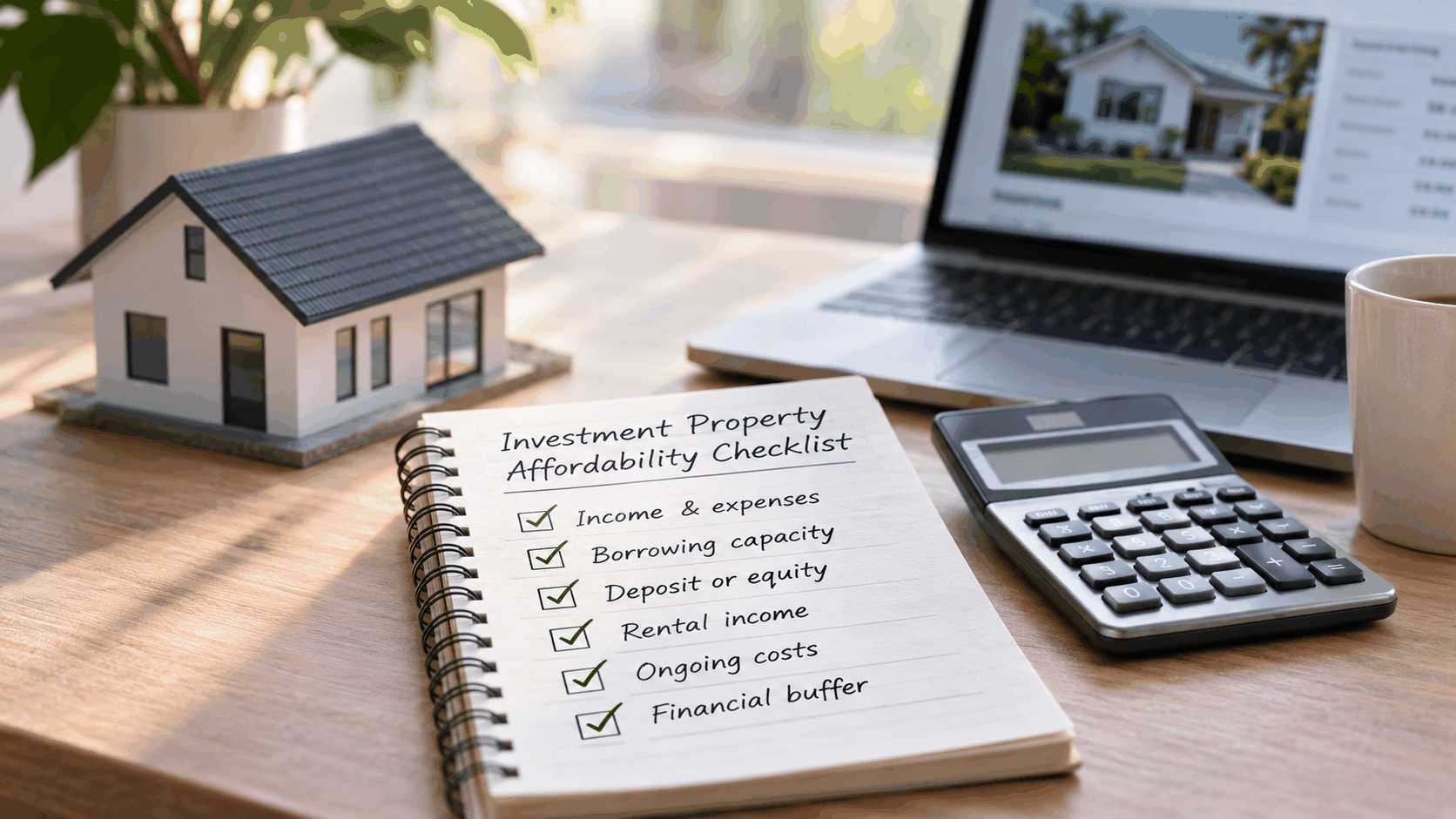
The answer depends on your equity, household income, debt obligations, available savings and investment objectives.
Using Equity in Your Existing Home to Build an Investment Property
If you’ve owned your home for several years, you may have accumulated equity through mortgage repayments, property value growth or both.
This equity could potentially help finance your second property.
What Is Usable Equity?
Equity is the difference between your property’s current market value and the amount owing on its mortgage.
Usable equity is the portion a lender may allow you to access, subject to its lending criteria.
Consider this hypothetical example:
| Your existing home | Amount |
|---|---|
| Current property value | $1,200,000 |
| Outstanding mortgage | $500,000 |
| Total equity | $700,000 |
| 80% of property value | $960,000 |
| Potential usable equity | $460,000 |
In this example, the homeowner has approximately $460,000 in potential usable equity at an 80% loan-to-value ratio.
This is not an automatic borrowing entitlement. A lender must assess the property’s valuation, your income, existing commitments, credit profile and capacity to service any additional debt.
How Can Equity Be Used?
Depending on lender approval, you may be able to access equity through:
- An additional loan split secured against your existing home.
- Increasing your current home loan.
- Refinancing to another lender.
- Combining available savings with released equity.
The funds could potentially help cover the land deposit, construction contribution or associated purchase costs.
However, equity is borrowed money, not free capital.
Using it increases your debt, and your existing home may be exposed to additional risk if repayments become difficult.
Keeping investment-related borrowing separate from private home borrowing may also help with record-keeping and tax administration. A qualified tax adviser should review the proposed structure.
For a broader explanation of equity, deposits and borrowing capacity, visit our Property Investor Finance Guide.
How Does a Construction Loan Work for an Investment Property?
A construction loan is designed to finance a property being built rather than one that is already complete.
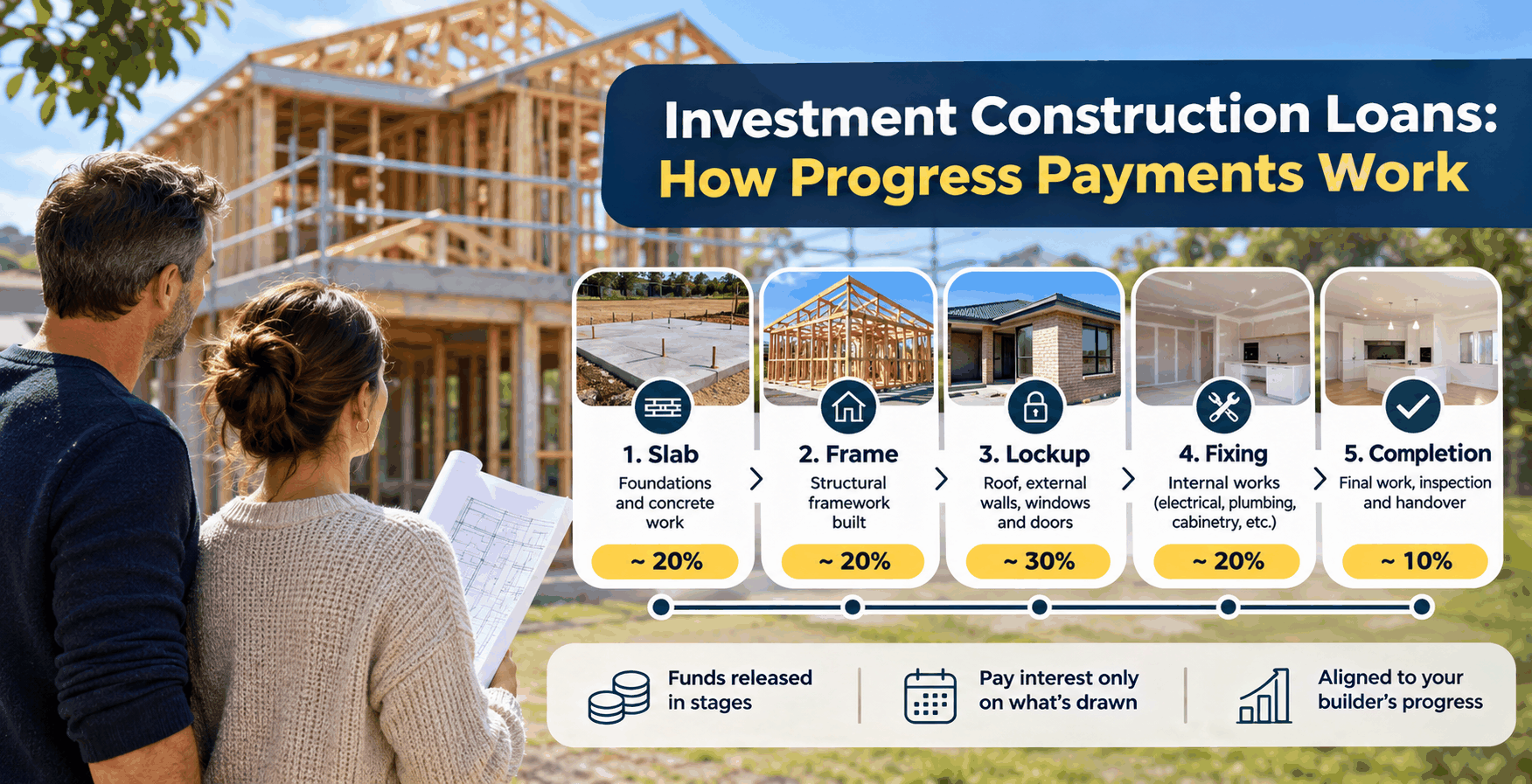
Unlike a standard mortgage, where the approved loan amount is generally advanced at settlement, a construction loan releases funds progressively.
These releases are called progress payments or progressive drawdowns.
Rather than paying the builder the full construction amount upfront, the lender releases money as agreed building milestones are completed.
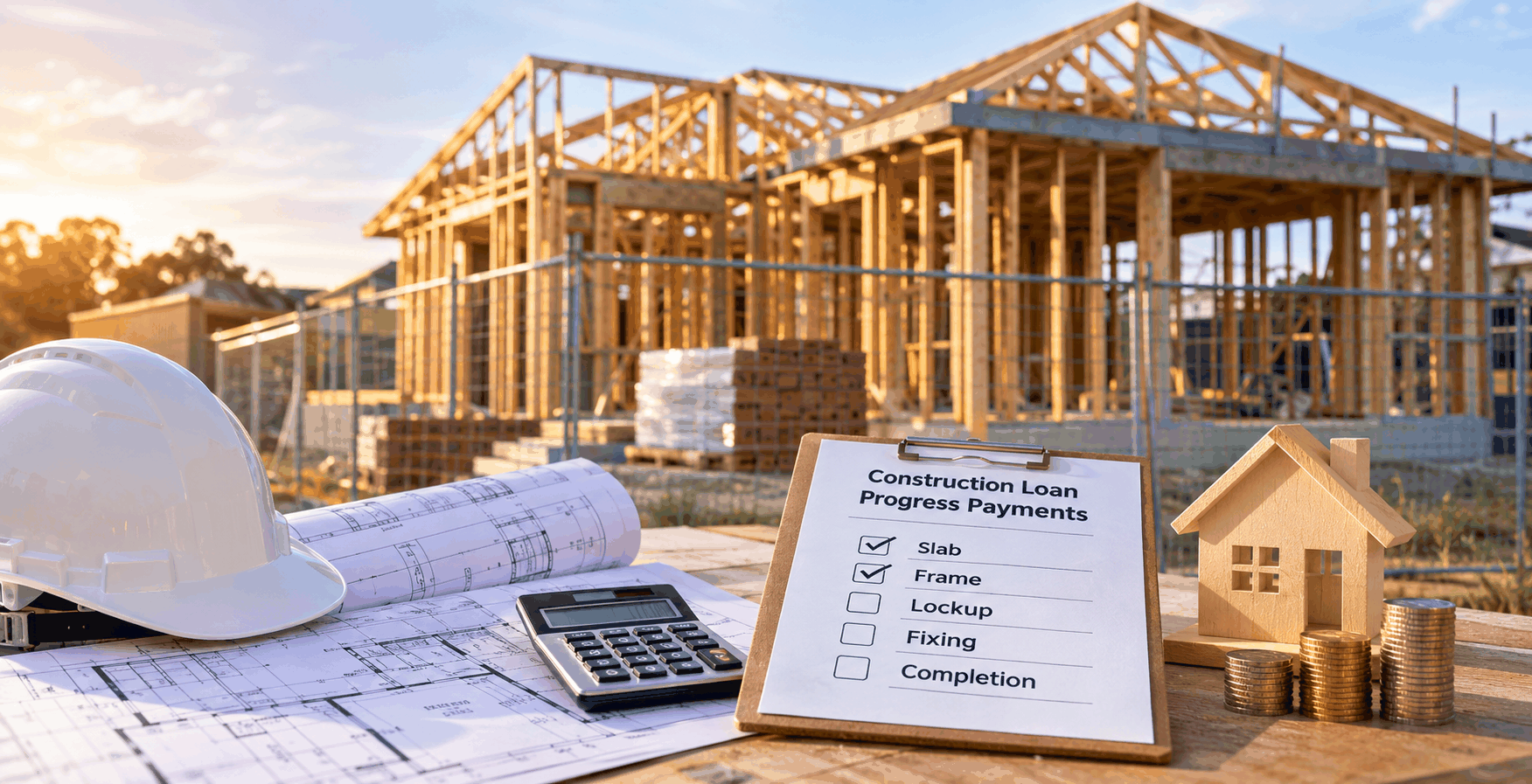
For example, payments may be linked to the slab, frame, lockup, fit-out and completion stages.
This approach helps align the loan funding with construction progress.
Do You Pay Interest During Construction?
With many construction loans, interest is calculated on the amount already drawn rather than the entire approved construction facility.
Some lenders also offer interest-only repayments during the construction period.
Consider a simplified example using an illustrative annual interest rate of 6.5%.
| Construction loan amount drawn | Approximate monthly interest |
|---|---|
| $100,000 | $542 |
| $200,000 | $1,083 |
| $300,000 | $1,625 |
| $400,000 | $2,167 |
These figures assume a constant balance and use annual interest divided by 12. Actual daily interest calculations, rates, fees and repayment requirements may differ.
Importantly, the example does not include interest on any separate land loan or equity release.
For an investor who already has a home mortgage, that distinction matters.
While your construction repayments may begin relatively low, your overall debt obligations can increase as more money is drawn.
How Much Does It Cost to Build an Investment Property in Australia?
The construction quote is only one part of the total investment.
Your budget may need to account for land acquisition, stamp duty, legal fees, site preparation, utility connections, landscaping, insurance and finance costs.
Consider the following hypothetical investment project.
| Expense | Estimated amount |
|---|---|
| Land purchase | $400,000 |
| Building contract | $380,000 |
| Stamp duty and legal costs | $20,000 |
| Site works and service connections | $25,000 |
| Landscaping and external works | $15,000 |
| Contingency allowance | $40,000 |
| Total estimated project budget | $880,000 |
These are illustrative figures, not estimates for a particular suburb or state. Actual costs can vary considerably based on location, construction type, land conditions and contract inclusions.
Finance interest and other holding costs during construction would need to be budgeted separately.
Why a Contingency Budget Matters
Even a fixed-price building contract may not cover every expense.
Additional costs can arise from soil conditions, variations, site access, drainage requirements, landscaping or items excluded from the original specification.
A contingency allowance can help protect your household budget from unexpected expenses.
For investors, it is especially important because the new property may not generate any income until construction and tenant preparation are complete.
How Much Deposit Do You Need?
The amount you need to contribute depends on the lender, the land value, the finished property’s valuation, the loan structure and your financial circumstances.
Many borrowers aim for an 80% loan-to-value ratio to potentially avoid lenders mortgage insurance, although lender policies and exemptions vary.
Using the hypothetical $880,000 project:
- Total project budget: $880,000
- Illustrative borrowing at 80% of total budget: $704,000
- Remaining funding requirement: $176,000
This is a budgeting illustration, not a lending assessment. A bank may use its own security valuation rather than the total amount spent, and some project costs may not be financeable.
The $176,000 contribution could potentially come from savings, usable equity or a combination of both.
Remember that funds drawn against your existing home are also debt. The lender will consider your overall borrowing position, not just the investment property’s loan.
Before purchasing land, have your finance options assessed against the entire project rather than the land purchase alone.
Investment Property Construction Timeline: From Planning to Tenants
Building a rental property involves several stages, each with different financial requirements.
A straightforward project might take around 12 to 24 months from initial finance planning through to tenant readiness, but this is an illustrative planning range rather than an industry guarantee.
Approval processes, land registration, builder availability, site complexity and location can significantly affect the schedule.
Stage 1: Review Borrowing Capacity and Equity
Illustrative planning allowance: 2 to 6 weeks
Start by understanding what you can reasonably afford.
A lender may review:
- Your current mortgage balance and property value.
- Household income and employment circumstances.
- Credit cards, personal loans and other liabilities.
- Savings and existing financial commitments.
- Potential rental income from the proposed investment property.
- Your ability to service borrowing at the lender’s assessment interest rate.
Conditional pre-approval can help establish your potential borrowing range, but it does not guarantee final construction loan approval.
Stage 2: Select Land and Assess the Investment
Illustrative allowance: 1 to 3 months or longer
Once you understand your budget, assess suitable locations.
Look beyond the advertised land price.
Research local rental demand, vacancy conditions, nearby schools, transport, employment centres and comparable rental properties.
Also check zoning, easements, flood exposure, soil conditions and building restrictions.
A cheaper block may become expensive if it requires substantial retaining walls, excavation or additional site works.
Engage appropriate legal and building professionals before committing to a contract.
Stage 3: Choose a Builder and Finalise Plans
Illustrative allowance: 2 to 4 months
Your builder will help determine the construction specifications, pricing and expected delivery schedule.
Lenders commonly request a signed building contract, approved plans, builder information, insurance documents and other supporting information.
A fixed-price contract may offer greater cost certainty, although exclusions and variations still require careful review.
Before signing, confirm what is included in the price and whether external works, flooring, appliances and essential tenant-ready features have been allowed for.
Stage 4: Final Construction Loan Approval
Illustrative allowance: 3 to 8 weeks after complete documentation
The lender may obtain an as-if-complete valuation of the finished property.
This valuation helps determine the security available for the proposed loan.
Approval may depend on the final contract, valuation, permits, builder credentials and your updated financial position.
If the valuation is lower than expected, you may need to contribute additional funds.
Construction should begin only when the required finance and commencement conditions have been satisfied.
Stage 5: Construction and Progress Payments
Illustrative allowance: 6 to 12 months or longer
Once construction commences, the builder completes the agreed milestones and requests payment.
The lender may require invoices, progress claim forms and inspections before releasing funds.
The schedule should be monitored closely because delays can affect interest expenses and the expected rental commencement date.
Stage 6: Handover and Tenant Preparation
Illustrative allowance: 2 to 6 weeks after construction completion
The final stage includes inspections, defect identification, completion documentation and the lender’s final payment requirements.
You may also need to arrange insurance, window coverings, landscaping, advertising and property management.
Rental income begins only once a tenant takes possession and becomes liable for rent.
For this reason, your financial projections should allow time between practical completion and the first rental payment.
Understanding the Five Construction Progress Payment Stages
Most residential construction funding follows a series of building milestones.
The exact number of stages and payment percentages depend on the contract and lender.
| Stage | Typical work completed | Finance consideration |
|---|---|---|
| Slab | Site foundations and concrete slab | First major construction drawdown |
| Frame | Structural framing and supporting components | Additional funds released |
| Lockup | Roofing, external walls, windows and doors | Increasing outstanding loan balance |
| Fit-out | Internal walls, kitchen, bathrooms and services | Larger cumulative interest costs |
| Completion | Final building works and inspections | Final payment and transition to ongoing loan arrangements |
As an example, a $400,000 construction contract might allocate payments of $80,000, $80,000, $80,000, $120,000 and $40,000 across these stages.
These percentages are illustrative and must not be treated as a standard or recommended payment schedule.
Each time an eligible payment is released, the outstanding construction balance increases.
Some lenders require you to use your agreed contribution before releasing their construction funds.
You should also ensure the builder’s payment schedule is acceptable to the lender before signing the contract.
Managing Two Mortgages During Construction
For homeowners building their second property, one of the biggest challenges is supporting their existing mortgage while funding the investment.
You may need to cover three separate commitments:
- Repayments on your primary residence.
- Interest or repayments on funds borrowed to purchase the investment land.
- Interest on progressive construction drawdowns.
Additional expenses may include council rates, insurance, land maintenance and finance fees.
There may be no rent to offset these expenses during construction.
Stress-Test Your Household Budget
Before proceeding, calculate whether your household can continue meeting its commitments if:
- Construction takes six months longer than expected.
- Interest rates increase by two percentage points.
- The finished property’s rent is lower than estimated.
- A variation requires an additional cash contribution.
- The property remains vacant for several weeks after completion.
These are scenarios to test, not predictions.
The key is to avoid relying on the most optimistic completion date or rental estimate.
If a project only works financially when everything goes exactly to plan, its risk may be too high for your circumstances.
Building Versus Buying an Established Investment Property
Both approaches can support a long-term property investment strategy.
| Consideration | Building a new property | Buying an established property |
|---|---|---|
| Rental commencement | After completion and tenant placement | Potentially soon after settlement |
| Property design | Greater choice before construction | Limited without renovations |
| Maintenance | Potentially lower initially | Depends on age and condition |
| Finance | May require staged construction funding | Generally a standard investment mortgage |
| Main risks | Delays, construction costs, builder performance | Existing defects, repairs, purchase price |
| Tax deductions | May offer eligible new construction depreciation | Depends on property and asset history |
The best decision depends on the numbers rather than whether the property is new or established.
Compare the total acquisition cost, financing expenses, likely rental income, maintenance, location and potential long-term returns.
A newly built property is not automatically a better investment because it is new.
Similarly, an established property is not automatically safer because it can be rented sooner.
Your investment goals and financial capacity should drive the decision.
Tax Considerations When Building an Investment Property
Property investment tax treatment can affect your after-tax cash flow.
However, deductions depend on the nature of the expense, the property’s use and Australian tax rules.
Construction Interest and Holding Costs
Interest incurred during construction may have different tax treatment from interest incurred once the completed property is available for rent.
Certain construction-period holding costs may also form part of the property’s cost base or receive other treatment under applicable tax rules.
Do not assume that every expense is immediately deductible simply because the property is intended to become a rental investment.
Depreciation and Capital Works
A new investment property may qualify for capital works deductions and eligible depreciation on certain assets.
The applicable treatment depends on the property, qualifying costs and the relevant rules.
A quantity surveyor’s depreciation schedule may help establish eligible deductions.
Ownership and Loan Structure
Whether the property is purchased individually, jointly, through a trust or another structure can influence financing and taxation.
It is sensible to discuss ownership and tax arrangements with appropriately qualified professionals before entering into binding purchase contracts.
Your accountant or registered tax adviser should confirm the treatment of construction interest, capital works and ongoing rental expenses.
What Happens if Construction Is Delayed?
Construction delays are particularly important for investors because they postpone rental income while holding costs continue.
Common causes include adverse weather, labour shortages, material availability, approval issues, variations and builder-related problems.
A delay can affect more than the handover date.
Your construction loan may have a maximum building period or require an extension if the project runs beyond the agreed schedule.
You may also need to review insurance, valuations or additional funding requirements.
How to Protect Your Investment
Before construction begins, ask the builder and lender:
- What happens if the project exceeds its expected completion date?
- Are there contract provisions covering delays or variations?
- How long is the approved construction loan period?
- What documentation is needed for an extension?
- How much additional holding cost can your household absorb?
Keep an accessible contingency reserve rather than committing every dollar of available equity to the project.
Can You Build an Investment Property Through an SMSF?
Some homeowners considering a second investment property also explore purchasing property through a self-managed superannuation fund (SMSF).
However, SMSF property finance operates under different rules from personal investment property construction lending.
An SMSF may be able to borrow for certain property acquisitions through a compliant limited recourse borrowing arrangement (LRBA).
But an SMSF generally cannot use LRBA borrowed money to construct a house on vacant land already owned by the fund. Borrowed funds also cannot be used for improvements that breach the LRBA rules.
Residential property held through an SMSF is also subject to restrictions on personal use and transactions involving related parties.
This means the conventional construction finance approach explained in this article should not be assumed to apply to an SMSF development.
SMSF property investment also involves additional legal, compliance, cash flow and retirement planning considerations.
If you are considering property investment through your superannuation rather than personally, seek specialist legal, tax and appropriately licensed financial advice before making any commitments.
NMC Finance can help you explore the financing considerations and whether a suitable SMSF lending pathway may be available, subject to your circumstances and applicable rules.
Why Choose NMC Finance for Your Next Investment Property?
When you already own a home, financing another property is rarely just about finding a competitive interest rate.
You need to consider your existing mortgage, usable equity, construction loan requirements, rental income, cash flow and future borrowing capacity.
NMC Finance helps Australian property investors understand their borrowing options and compare suitable lending structures.
More Than 20 Years of Finance Experience
Led by Nathan Coad, NMC Finance brings more than 20 years of consumer and commercial banking experience to borrowers seeking property and investment finance.
This experience helps clients navigate lender requirements, finance applications and complex borrowing decisions.
Access to a Broad Lender Panel
NMC Finance has access to a panel of more than 50 lenders.
Because lender policies vary, comparing options can be particularly valuable when you need to finance land, release equity or obtain approval for a construction project.
Not every lender or product will be suitable or available for every project.
Help With Equity and Loan Structure
NMC Finance can review your existing mortgage position, estimated equity and borrowing requirements.
The goal is to help you understand how financing another property could affect your current repayments, cash flow and future investment plans.
Support From Planning to Settlement
Rather than considering the investment loan in isolation, NMC Finance can help you navigate the finance process from initial borrowing assessment through to application and settlement.
For suitable construction lending arrangements, this includes helping you understand lender documentation, finance conditions and progress payment requirements.
NMC Finance also supports property investors who wish to understand SMSF property finance options, where specialist rules and eligibility requirements apply.
Thinking about building your first investment property?
Explore NMC Finance’s Property Investor Finance Solutions or arrange a consultation to discuss your equity, borrowing capacity and financing options.
Frequently Asked Questions About Building an Investment Property in Australia
1. Can I use equity in my home to build an investment property?
Yes, eligible homeowners may be able to borrow against usable equity in their existing property to help fund a second property. The amount available depends on the lender’s valuation, loan balance, borrowing capacity and lending criteria. Accessing equity increases your total debt and repayment obligations.
2. How much deposit do I need to build an investment property?
Many investors aim to contribute enough to keep borrowing at or below 80% of the lender’s accepted security value, potentially avoiding lenders mortgage insurance. Some lenders may allow higher borrowing ratios. The required contribution depends on the project, valuation, financial circumstances and loan structure.
3. How long does it take to build an investment property in Australia?
A residential build might take six to twelve months or longer once construction starts. The complete process, including finance, land purchase, design, approvals and tenant preparation, may take considerably longer. Timelines vary by location, builder and project complexity.
4. Do I need to pay my construction loan while the property is being built?
Yes. Construction loans generally require repayments during the building period. Some lenders offer interest-only repayments on progressively drawn funds. You must also continue meeting repayments on your existing home loan and any separate land or equity facilities.
5. Can expected rental income help me qualify for a construction loan?
Some lenders may consider forecast rental income when assessing investment property borrowing capacity. They may require evidence such as a rental appraisal and may only recognise a portion of the forecast rent. Treatment varies between lenders, especially before the property has been completed.
6. Can I buy land first and arrange construction finance later?
Yes, some investors purchase land using savings, equity or a land loan before applying for construction finance. However, future approval is not guaranteed. Changes in income, interest rates, land value or building costs could affect your ability to finance the eventual build.
7. Is it better to build or buy an established investment property?
Building may offer modern features, design flexibility and potential depreciation benefits. Buying established may allow earlier rental income and avoid construction-related risks. Compare total costs, achievable rent, location, financing and your tolerance for delays before deciding.
8. What happens to my construction loan when the property is finished?
After the final documentation and payments are completed, the loan generally moves from the construction phase to its agreed ongoing repayment arrangement. The timing of principal and interest repayments depends on the lender and loan contract. You may also consider reviewing your finance once the property is completed.
9. Can I claim construction loan interest as a tax deduction?
Interest and holding costs incurred while constructing a future rental property may be subject to specific tax rules, including restrictions on immediate deductions. The treatment depends on the circumstances. Seek advice from a registered tax adviser rather than assuming all construction-period interest is deductible.
10. Can my SMSF borrow money to build an investment property?
SMSF borrowing is subject to strict limited recourse borrowing rules. In particular, an SMSF generally cannot use borrowed LRBA funds to construct a house on vacant land it already owns. Anyone considering SMSF property development should obtain specialist legal, tax and financial advice before proceeding.
Final Thoughts: Plan the Finance Before You Start Building
Building an investment property can be a practical way for existing homeowners to expand their property portfolio.
Your current home may provide equity that helps make the next purchase possible. But the decision should be based on your overall financial position, not simply the amount of equity available.
Construction lending involves staged payments, evolving interest costs and a period when the property is not generating rental income.
Planning for those obligations before purchasing land can help you make a more informed decision and avoid unnecessary financial pressure.
NMC Finance helps Australian property investors review borrowing capacity, explore equity options, compare suitable lenders and understand finance structures for their next investment.
Ready to take the next step?
Speak with NMC Finance about your investment property financing options and find out what may be possible based on your existing property, borrowing position and long-term goals.
General information only. This article does not constitute personal financial, tax or legal advice. Loan eligibility, lender policies, borrowing capacity and repayments depend on individual circumstances. Construction budgets and timelines are illustrative, not guarantees. Seek independent professional advice before making investment decisions.