
⏱ Estimated reading time: 20 min read
If you already own your home and are planning to build a second property as an investment, understanding construction loan progress payments is essential.
Unlike purchasing an established investment property, where your lender generally advances the loan at settlement, building a new property involves releasing funds to your builder at different stages of construction.
These payments are known as construction loan progress payments or progressive drawdowns.
Each payment affects how much you owe, how much interest you pay and how much money you need available while your investment property is being built.
For existing homeowners, this becomes particularly important because you may already be making repayments on your primary residence while financing a second property that has yet to generate rental income.
Understanding when your builder gets paid, what your lender checks and how repayments change can help you avoid unnecessary financial pressure.
This guide explains how investment construction loan progress payments work in Australia, with a practical example and the important questions investors should ask before construction begins.
If you’re considering financing a second property, NMC Finance’s property investor finance specialists can help you review suitable lending options and understand how the proposed loan structure may affect your existing mortgage.
What Are Progress Payments on an Investment Construction Loan?
Progress payments are instalments paid to a builder when agreed construction milestones have been completed.
Instead of receiving all your approved construction funds upfront, you access the money in stages.
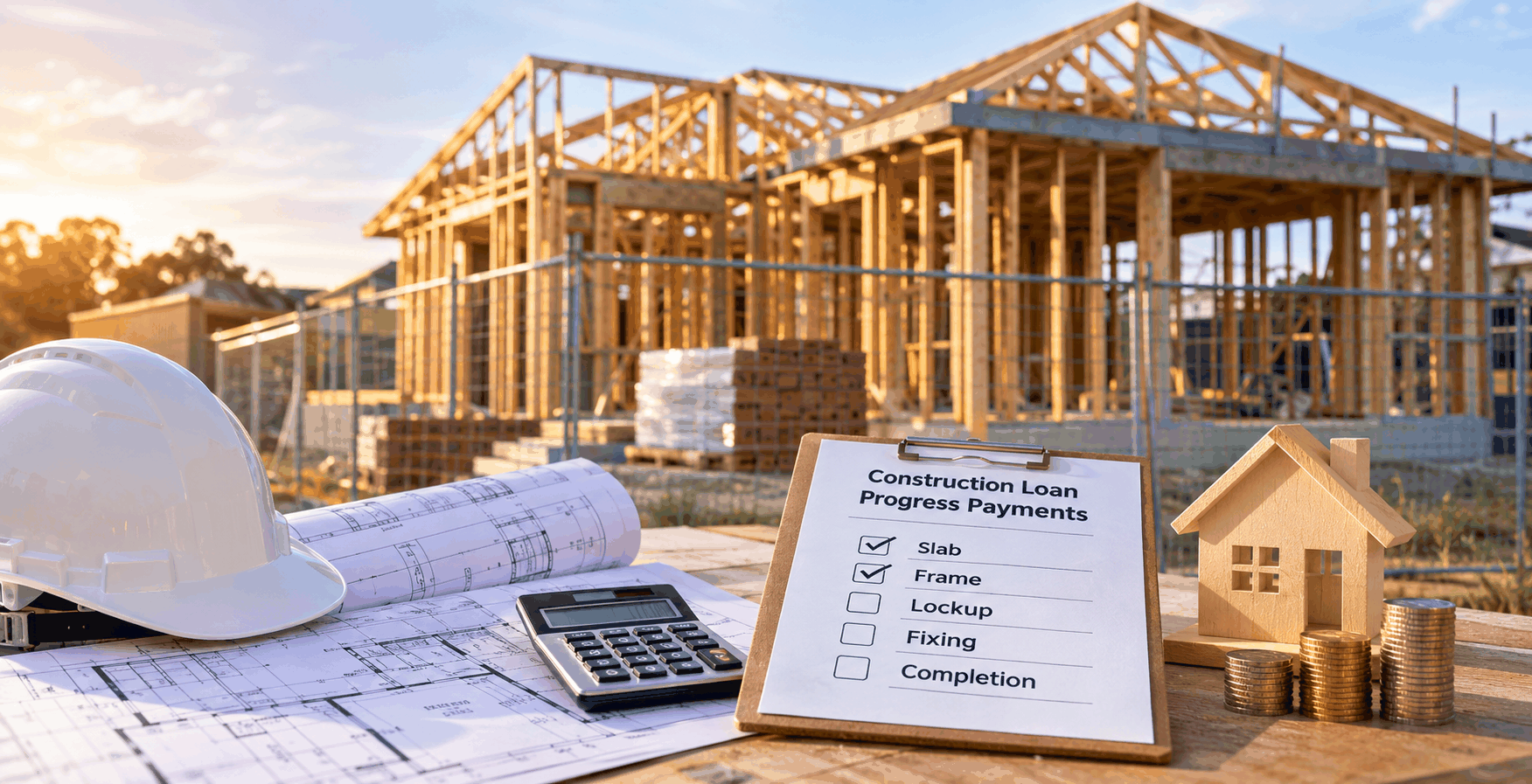
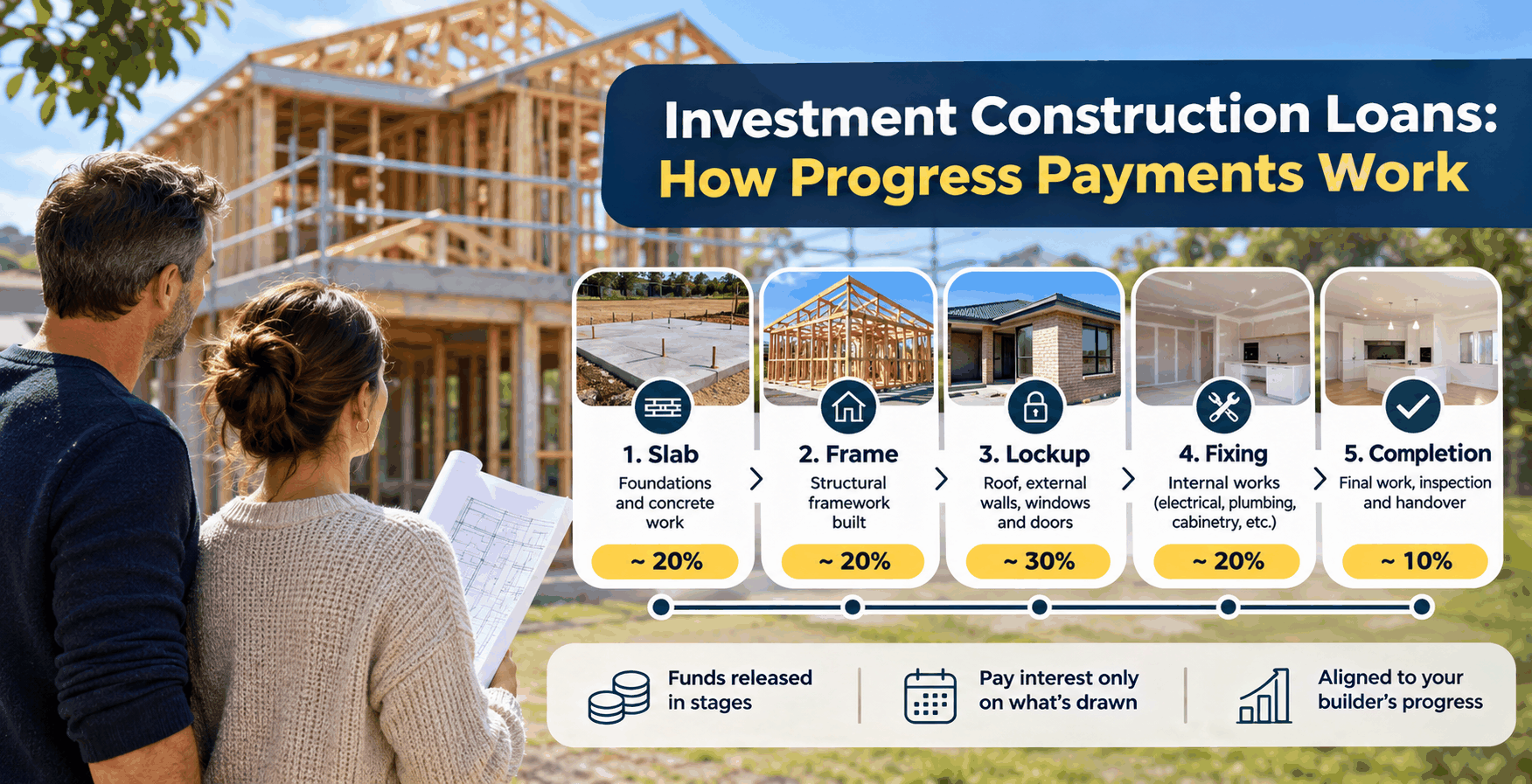
For example, your builder may receive a payment once the concrete slab is finished, another when the framing is complete and further payments as the property reaches lockup, fixing and final completion.
The schedule is usually established in your building contract and must be acceptable to your lender.
A typical process involves:
- The builder completes an agreed construction stage.
- The builder issues a progress payment invoice.
- You review the invoice and authorise payment.
- The lender checks the documents and may arrange an inspection.
- The lender releases the approved funds, generally to the builder.
This process helps ensure that construction funding is linked to work completed rather than being provided entirely in advance.
For property investors, it also means the outstanding construction loan balance grows progressively.
You are generally charged interest on the amount drawn, not the entire approved construction facility.
How Are Investment Construction Loans Different From Standard Investment Loans?
The main difference is how and when the funds are released.
With an established investment property, the lender typically advances the loan at settlement.
With a construction loan, funds for the building work are released at agreed milestones.
| Feature | Standard investment loan | Investment construction loan |
|---|---|---|
| Funds released | Generally, at settlement | Progressively during construction |
| Payment recipient | Usually, the property seller | Generally, the contracted builder |
| Interest calculation | On the outstanding loan balance | On the progressively drawn balance |
| Property valuation | Existing property value | Often based on proposed completed value |
| Lender documentation | Purchase and finance documents | Building contract, plans, approvals and progress claims |
| Repayments | According to the selected loan terms | Often interest-only during construction, subject to lender terms |
One important distinction is that an investment construction loan is not necessarily one account covering every part of the project.
You may have a separate land loan, an equity release secured against your existing home and a construction facility.
Each can have different repayment obligations.
This is why the monthly interest on the construction drawdowns may represent only part of your total investment financing cost.
The Five Stages of Construction Loan Progress Payments
Most Australian residential building contracts use five broad construction stages.
The names, percentages and precise definitions can vary between builders, contracts and lenders.
1. Slab or Base Stage
The slab stage generally involves site preparation, foundations and concrete work.
For many projects, this is the first major stage at which a builder requests payment under the construction contract.
Before releasing funds, your lender may require the builder’s invoice, your authorisation and confirmation that the relevant work has been completed.
For investors, the important consideration is whether the agreed first payment is covered by available loan funds or must initially be paid from your own contribution.
2. Frame Stage
The framing stage involves constructing the structural framework of the property.
This may include external and internal wall framing, structural supports and roof framing, depending on the contract.
Once the stage is completed, your builder submits another progress claim.
After the lender approves the drawdown, your construction loan balance increases.
Your interest expense will generally increase accordingly.
3. Lockup Stage
At lockup, the property typically has its roof, external walls, windows and doors sufficiently installed to secure the building.
This stage can represent a substantial proportion of the building contract.
Because more of the approved construction funds have now been released, your outstanding loan balance may be considerably higher than during the earlier stages.
It’s a useful point to review your household cash flow against the remaining construction period.
4. Fixing or Fit-out Stage
The fixing stage generally covers substantial internal works.
Depending on the building contract, this may include plastering, internal doors, cabinetry, plumbing fixtures, electrical fittings and other interior finishes.
Before authorising payment, check that the builder’s claim corresponds with the agreed contractual milestone.
If you have concerns about incomplete or defective work, consider obtaining advice from an appropriately qualified building inspector before approving the claim.
5. Practical Completion
Practical completion is the final major stage.
The builder completes the contracted work and prepares the property for handover, subject to any outstanding matters identified under the contract.
Your lender may require a final inspection and supporting documents before releasing the last payment.
You should also arrange your own building inspection and review any defects or incomplete items before signing completion documentation.
For an investment property, lender completion and tenant readiness are not necessarily the same thing.
You may still need to arrange landscaping, window coverings, insurance or other items before advertising for tenants.
Construction Progress Payment Example: A $450,000 Investment Build
Consider a homeowner who already has a mortgage on their primary residence.
They purchase land for a future rental property and obtain approval for a $450,000 construction facility.
For simplicity, assume the land finance and any equity release have already been arranged separately.
The following table illustrates how the construction funds could be released.
| Construction stage | Payment percentage | Payment amount | Total drawn |
|---|---|---|---|
| Slab | 20% | $90,000 | $90,000 |
| Frame | 20% | $90,000 | $180,000 |
| Lockup | 30% | $135,000 | $315,000 |
| Fixing | 20% | $90,000 | $405,000 |
| Completion | 10% | $45,000 | $450,000 |
| Total | 100% | $450,000 |
These percentages are illustrative. They do not represent a standard payment schedule that every lender or builder must follow.
What Does This Mean for the Investor?
At the first stage, only $90,000 has been drawn from the construction facility.
After the frame stage, the outstanding amount increases to $180,000.
By lockup, $315,000 has been drawn.
Once the final payment is made, the full $450,000 has been advanced.
The important point is that your interest expense generally increases as construction progresses.
However, your existing home mortgage and any land finance remain separate obligations.
Your actual total repayments will depend on the combined balances, interest rates and agreed loan terms.
How Much Interest Do You Pay on Construction Progress Payments?
One benefit of progressive drawdowns is that you generally pay interest only on the amount actually released.
This can reduce interest expenses compared with drawing the full construction amount at the beginning.
Using the $450,000 example, assume a hypothetical interest rate of 6.5% per annum and an interest-only construction repayment arrangement.
| Stage | Outstanding balance | Approximate monthly interest |
|---|---|---|
| Slab | $90,000 | $488 |
| Frame | $180,000 | $975 |
| Lockup | $315,000 | $1,706 |
| Fixing | $405,000 | $2,194 |
| Completion | $450,000 | $2,438 |
The figures use a simplified monthly calculation and assume the full stated balance remains outstanding throughout the month.
Actual lenders typically calculate interest daily. Your monthly interest will depend on the dates funds are released, the daily balance, interest rate changes and applicable loan terms.
Why Payment Dates Matter
Suppose your builder completes the framing stage midway through the month.
Your construction balance increases from $90,000 to $180,000 only when the second payment is released.
You generally do not pay interest on the extra $90,000 before it is drawn.
This makes the timing of payments relevant to your cash flow.
However, delaying a legitimate builder payment merely to save interest can breach your building contract and create project delays.
The aim should be to ensure claims are accurate, supported and processed on time.
What About Your Existing Mortgage?
Imagine you’re still paying $2,800 per month on your family home.
At the fixing stage, the example construction interest is approximately $2,194 per month.
That creates combined monthly repayments of approximately $4,994 before accounting for land finance, equity borrowing, rates, insurance and other holding costs.
For someone building their first rental property, understanding this combined commitment is often more useful than looking at the construction loan in isolation.
For help reviewing suitable investment loan structures, explore NMC Finance’s Property Investor Loans.
How to Request a Construction Progress Payment
Although individual lenders have different procedures, the process generally follows a similar sequence.
Step 1: Receive the Builder’s Invoice
Your builder submits an invoice after completing the agreed construction milestone.
Check the invoice against your contract’s payment schedule.
Confirm that the amount, stage and project details are correct.
Step 2: Review the Completed Work
Before authorising payment, make sure the claimed milestone has actually been reached.
Your builder’s confirmation does not replace your own contractual responsibilities.
Where appropriate, engage an independent building inspector to assess the work.
A lender’s valuation inspection is primarily for lending purposes and should not be relied upon as a comprehensive building quality inspection.
Step 3: Authorise the Payment
Your lender may require you to sign the invoice, complete a progress payment instruction form or provide another written authorisation.
Some lenders allow electronic submission.
Make sure the required documents are complete and that the payment details match the approved construction arrangements.
Step 4: The Lender Reviews the Claim
The lender checks that the requested payment aligns with the building contract and available construction funding.
Depending on its policy, the lender may arrange an inspection or request further evidence.
Missing documents or discrepancies can delay the release of funds.
Step 5: Funds Are Released
Once the claim is approved, the lender generally pays the builder directly.
Some lenders may reimburse you if you have already made an eligible payment using your own funds.
Keep copies of the invoice, lender confirmation and any supporting documentation.
These records can be useful for construction administration, finance reviews and future tax discussions.
What Documents Are Required for Progress Payments?
Documentation requirements vary, but common items include:
- The builder’s progress payment invoice.
- A completed payment request or instruction form.
- Your signed payment authorisation.
- Supporting inspection or valuation documents, where required.
- Receipts for any payments made from your own contribution.
- Updated contract variation documents, if applicable.
At the final stage, the lender may request additional completion documents and evidence of required insurance or approvals.
For investors, having these documents organised can reduce administrative delays.
It can also help you track how much of the approved construction facility has already been used.
Do You Need to Use Your Own Money Before the Bank Releases Funds?
In some construction loan arrangements, the lender requires you to contribute your agreed funds before it begins releasing construction finance.
This is sometimes described as the borrower contributing their funds first.
For example, you may have agreed to contribute $60,000 of your own money towards a $450,000 building contract.
Depending on the approved structure, you could be required to pay that contribution directly to the builder before the lender makes its first construction drawdown.
That $60,000 might come from savings or funds borrowed against your existing property.
The important distinction is that borrowing against your home does not turn the money into savings. It creates another debt obligation.
Before your builder starts work, ask your lender to confirm:
- How much you must contribute.
- When that contribution must be paid.
- Whether the payment is made directly to the builder.
- What proof of payment is required.
- When the first lender-funded drawdown will become available.
Misunderstanding the contribution order can create a funding gap even when the overall loan has been approved.
What Happens if the Builder’s Payment Schedule Does Not Match the Lender’s?
A mismatch between the building contract and your lender’s approved progress payment schedule can create problems.
For example, your builder might request 35% of the contract value at lockup, while the lender-approved schedule provides for a smaller amount at that stage.
The lender may decline to release the full requested amount until its conditions are met.
The difference could leave you needing additional funds or negotiating a revised payment arrangement.
This is one reason to have your proposed building contract and payment schedule reviewed for lender acceptability before signing.
How Can Investors Avoid Payment Disputes?
Ensure that:
- Progress claims relate to clearly defined completed work.
- The lender accepts the proposed payment stages.
- Contract variations follow the agreed approval process.
- You understand the required borrower contribution.
- There is enough time between receiving an invoice and its due date for lender processing.
Building contracts and deposit rules can differ between Australian states and territories, so obtain appropriate legal advice on the contractual payment terms.
A finance broker can help clarify lender requirements, while a solicitor or building contract specialist can advise on your contractual obligations.
What Happens if a Progress Payment Is Delayed?
A progress payment can be delayed if the lender has not received the necessary documents or if an inspection identifies issues requiring clarification.
Delays may also arise when a builder requests payment before the contractual milestone is complete.
For an investor, this can create several problems.
The builder may postpone further work, the expected handover date may move, and additional holding expenses may accumulate.
You may also need to manage communication between the builder, lender and inspector.
What Should You Do?
Start by identifying why the payment has not been approved.
If the issue is missing documentation, provide the required information promptly.
If the lender questions the stage of completion, seek clarification and avoid approving work that has not been completed to the required contractual milestone.
If there is a dispute with the builder, obtain appropriate independent building or legal advice.
The goal is to resolve the actual issue rather than simply requesting faster payment.
Can Progress Payments Increase if Building Costs Change?
Not every construction expense is automatically covered by the approved loan.
Suppose your builder identifies additional drainage work costing $18,000.
Even if the variation is legitimate, your lender may not agree to increase the existing construction facility.
The lender may need to reassess the project, the completed valuation and your borrowing capacity.
You might need to cover the additional amount yourself.
This can become especially challenging when the extra expense arises after much of the construction loan has already been drawn.
Before accepting a variation, confirm its cost, contractual implications and financing arrangements.
Investors should maintain a separate financial buffer rather than assuming unused loan funds will be available for every unexpected expense.
How Progress Payments Affect Investors With an Existing Home Loan
If you’re building a second property, your financial position differs from that of someone building their first family home.
You may have an established mortgage, ongoing household expenses and possibly an equity loan supporting the investment.
At the same time, the new property may not produce rental income until construction is complete and a tenant moves in.
This creates a period when your borrowing obligations can increase without a corresponding increase in rental income.
Monitor Your Combined Repayments
Review your construction loan drawdowns alongside repayments on your other facilities.
For example, a relatively small initial construction payment may be manageable.
But later-stage drawdowns can materially increase your monthly interest expenses.
Maintain a Cash Reserve
Consider keeping funds available for:
- Construction-related interest and repayments.
- Council rates and property insurance.
- Unexpected building variations.
- Additional time before the property is rented.
- Normal family and household expenses.
The appropriate amount depends on your project, financial circumstances and risk tolerance.
Review Interest-only Arrangements
Some construction loans allow interest-only repayments during the build.
This can help manage short-term cash flow, but interest-only repayments generally do not reduce the principal.
Once the interest-only period ends, principal and interest repayments may be higher.
Investors should understand when the repayment change will occur and whether the resulting amount is affordable.
What Happens After the Final Progress Payment?
After the lender approves the final progress claim, the construction facility has generally been fully drawn.
The loan then follows the ongoing repayment arrangements specified in the loan agreement.
Depending on the product, this may involve moving to principal and interest repayments when the construction or agreed interest-only period ends.
Some investment loans may continue on an approved interest-only arrangement for a longer period.
You should review the repayment amount, interest rate and remaining loan term before completion.
You may also want to review whether the loan structure remains appropriate once the property is generating rental income.
For example, your priorities may shift from managing construction payments to maintaining rental cash flow and preparing for a future investment purchase.
The completion of construction does not necessarily mean refinancing is required, but it can be a useful opportunity to review your arrangements.
Common Construction Progress Payment Mistakes Investors Should Avoid
Several avoidable mistakes can complicate construction finance.
Approving invoices before work is complete. Always check that the relevant contractual milestone has been achieved.
Assuming the lender will automatically pay every invoice. Each claim remains subject to the lender’s requirements and available approved funding.
Overlooking the initial cash contribution. Confirm whether your contribution must be used before construction loan funds.
Ignoring payment processing time. Allow sufficient time for inspections, document checks and payment approval.
Underestimating combined repayments. Include your home loan, land finance and equity borrowing when reviewing cash flow.
Making unapproved building variations. Changes to the contract may affect lender approval or create additional funding requirements.
Treating lender inspections as building quality guarantees. Use an independent building professional where appropriate.
These precautions are particularly valuable when your household is supporting two properties simultaneously.
Why Choose NMC Finance for Investment Construction Loans?
Financing a second property is not simply about obtaining approval for the building contract.
Your current mortgage, borrowing capacity, available equity and repayment commitments all influence how comfortably you can manage the project.
NMC Finance helps Australian property investors understand their borrowing options and compare suitable lending arrangements.
Over 20 Years of Finance Experience
NMC Finance brings more than 20 years of banking and finance industry experience.
This can be valuable when navigating lender requirements, comparing repayment structures and understanding the financial implications of a construction project.
Access to Multiple Lenders
NMC Finance works with a broad range of lenders, including major banks and other lending providers.
Because construction loan requirements differ, comparing suitable lenders can help you understand your available options rather than relying on a single bank’s policies.
Lender availability and eligibility remain subject to individual circumstances.
Finance Guidance That Considers Your Existing Home
If you already have a residential mortgage, your investment borrowing should be considered alongside your existing obligations.
NMC Finance can help you review estimated repayments, available equity, borrowing capacity and suitable loan structures.
This includes understanding how construction funding may interact with your current mortgage.
Support Understanding Construction Funding Requirements
Progress payments involve invoices, stage approvals, lender documentation and sometimes inspections.
NMC Finance can help you understand the relevant lender requirements and finance process, so you know what information may be needed as your project progresses.
A Long-term Property Investment Perspective
Once construction finishes, your financial priorities may change.
You may want to review your repayments, manage rental income or consider your capacity for another investment.
NMC Finance helps investors consider finance options in the context of their broader property goals.
Already own a home and planning to build an investment property?
Explore NMC Finance’s Property Investor Loan Solutions or arrange a free consultation to discuss your mortgage, potential borrowing options and proposed construction funding.
Frequently Asked Questions About Construction Loan Progress Payments
1. How do construction loan progress payments work in Australia?
Construction loan progress payments are staged releases of approved funds as a builder completes agreed milestones. The builder submits an invoice; you authorise the request and the lender checks the relevant requirements before releasing funds. Depending on the lender, inspections or additional documents may be required.
2. What are the five stages of construction progress payments?
The five common stages are slab or base, frame, lockup, fixing and practical completion. The definition of each stage and the percentage payable depend on the building contract and lender-approved schedule.
3. Do I pay interest on the full construction loan amount?
Generally, construction loan interest is charged only on the outstanding amount already drawn, rather than the total approved construction facility. Other loans, including land finance and home equity borrowing, may incur interest separately.
4. Can I use equity from my existing home for construction progress payments?
Potentially, yes. Some investors use funds released against their existing home as part of their required construction contribution. Access depends on lender approval, usable equity and borrowing capacity. Releasing equity also increases your debt obligations.
5. Who pays the builder during construction?
The construction lender generally releases approved progress payments directly to the contracted builder. Some lenders may reimburse the borrower for eligible payments already made, subject to their requirements and available funds.
6. How long does a construction progress payment take?
Processing times vary between lenders. Missing documentation required inspections and payment discrepancies can cause delays. Ask your lender for its current processing requirements and submit complete documents before the contractual payment deadline.
7. What happens if the bank refuses a progress payment?
The lender may require further documents, clarification or confirmation that the relevant work has been completed. If the claim does not meet the approved conditions, funds may not be released until the issue is resolved. Seek building or legal advice where a contractual dispute arises.
8. Can I choose interest-only repayments during construction?
Some lenders offer interest-only construction loan arrangements. Eligibility and the permitted period depend on the loan product and lender. Once the interest-only period ends, your repayment obligations may increase when principal repayments begin.
9. Can I change builders during construction?
Changing builders may be possible, but it can require lender approval, revised contracts, further valuations and updated insurance or construction documents. Do not assume that the remaining construction funds can automatically be transferred to a new builder.
10. What happens after the final construction progress payment?
Once the final payment and completion requirements are satisfied, the loan continues under its agreed repayment terms. Your interest-only arrangement may end, depending on the contract, and your repayments may change. This is also an appropriate point to review your investment loan structure.
Final Thoughts: Understand Every Drawdown Before You Build
Progress payments are central to how investment construction loans operate.
They determine when your builder receives money, how your outstanding construction balance increases and how your interest expenses change throughout the project.
For homeowners building a second property, understanding these payments can help you manage your financial commitments while the investment is not yet generating rental income.
Before signing a building contract, make sure the progress payment schedule is acceptable to your lender, understand your required contribution and confirm what happens if the project costs change.
Most importantly, assess the construction repayments together with your existing home mortgage and other commitments.
Planning to finance a second property?
Speak with NMC Finance about your investment property finance options and understand how a suitable lending structure could support your next investment.
General information only. This article does not constitute personal financial, legal or tax advice. Loan approval, construction progress payment requirements, repayment options and interest rates vary by lender and individual circumstances. Financial examples are illustrative. Obtain independent legal and building advice where appropriate before entering into contracts or authorising disputed payments.