
⏱ Estimated reading time: 21 min read
Building a new investment property in Australia could offer significant financial advantages over purchasing an established home, especially with major changes to negative gearing and capital gains tax taking effect from 1 July 2027.
For property investors, the decision is no longer simply about whether construction is cheaper than buying an existing house. It is increasingly about tax efficiency, rental cash flow, depreciation, financing flexibility and long-term wealth creation.
Under Australia’s new tax rules, eligible newly constructed investment properties will retain certain advantages, including the ability to offset qualifying investment losses against salary income and greater flexibility in how capital gains are taxed.
Combined with potential depreciation deductions, lower initial maintenance costs and modern rental features, building new may become an attractive strategy for Australians looking to acquire their first investment property or expand an existing property portfolio.
However, building is not automatically the better investment. Construction delays, unexpected costs, rental demand and borrowing capacity all influence the outcome.
At NMC Finance, we help Australian property investors understand their financing options, assess borrowing capacity and structure investment loans around their individual circumstances.
This guide explores the key differences between building and buying an investment property, including how the upcoming tax changes could influence investment decisions.
Is It Better to Build or Buy an Investment Property in Australia?
Quick Answer: Building a new investment property may offer better tax flexibility than purchasing an established property after Australia’s May 2026 tax reform cutoff. From 1 July 2027, eligible new builds retain negative gearing benefits against salary income and offer a choice of capital gains tax treatments.
Other potential advantages include:
- Greater depreciation deductions on qualifying construction costs and new assets.
- Lower initial maintenance requirements.
- Modern designs and energy-efficient features that may attract tenants.
- Opportunities to customise the property for local rental demand.
- Long-term capital growth potential in suitable locations.
Buying an established property may still make sense for investors seeking immediate rental income, established neighbourhoods and fewer construction-related risks.
The best strategy depends on total investment costs, rental income, financing arrangements, tax treatment and long-term investment objectives.
Whether you are considering your first rental property or expanding an established portfolio, reviewing your property investment loan options can help you understand how much you may be able to borrow.
1. Building vs Buying an Investment Property: Key Differences
Before focusing on the tax benefits, investors should understand how new construction compares with purchasing an established rental property.
| Investment Factor | Building a New Property | Buying an Existing Property |
|---|---|---|
| Upfront investment | Land, construction and associated expenses | Property purchase price and transaction costs |
| Negative gearing from July 2027 | Eligible new builds retain salary-offset benefits | Restricted for properties acquired after May 2026 cutoff |
| Capital gains tax | Eligible choice of two tax treatments | Generally subject to new treatment for post-July 2027 gains |
| Depreciation | Often greater deductions | Depends on age, improvements and asset eligibility |
| Maintenance | Potentially lower initial maintenance | May require repairs or renovation |
| Rental income | Begins after construction and leasing | May commence shortly after settlement |
| Property design | Can be tailored to tenant demand | Existing floor plan and features |
| Financing | Construction loan with progress payments | Standard investment property loan |
| Risks | Builder delays, cost overruns and valuation issues | Existing defects, repairs and market risk |
| Capital growth | Depends on location and demand | Depends on location and demand |
The key takeaway is that a newly constructed property may provide additional financial flexibility, but the investment must still perform commercially.
A property offering attractive tax deductions may not be worthwhile if construction costs are excessive or rental demand is weak.
2. Negative Gearing: Why Building New Could Become More Attractive
Negative gearing has traditionally been an important consideration for Australian property investors.
It occurs when the tax-deductible expenses associated with an income-producing investment exceed the income generated by that investment.
For example, imagine an investor who earns $30,000 in annual rental income but incurs $42,000 in eligible deductible expenses.
The property generates a $12,000 taxable rental loss.
Under the applicable negative gearing rules, that loss may be deducted against other taxable income, potentially reducing the investor’s income tax liability.
What Is Changing with Negative Gearing in Australia?
The Australian Government’s 2026–27 Budget introduced significant reforms to negative gearing for residential investment properties.
From 1 July 2027, negative gearing benefits that allow investors to offset rental losses against salary and other non-property income will generally be limited to eligible newly constructed residential properties and qualifying grandfathered investments.
The reforms distinguish between eligible new homes and established properties acquired after 7:30 pm AEST on 12 May 2026.
| Property Type | Negative Gearing Treatment from July 2027 |
|---|---|
| Eligible newly constructed investment property | Qualifying rental losses may offset salary and other income |
| Established investment property acquired before 12 May 2026 cutoff | Existing negative gearing arrangements remain protected |
| Established investment property acquired after cutoff | Rental losses generally cannot offset salary income |
| Established property with restricted losses | Eligible losses may offset residential property income or gains, with unused losses carried forward |
These changes could make eligible new-build investment properties particularly attractive to salaried professionals.
How Negative Gearing Can Reduce Income Tax
Consider an investor earning $150,000 annually from employment.
They build an eligible new investment property and, after accounting for rental income and qualifying deductions, record a taxable rental loss of $20,000.
If the investor qualifies to offset the entire amount against employment income, their taxable income could decrease from $150,000 to $130,000.
At an illustrative marginal tax rate of 39%, including Medicare levy, that $20,000 deduction could reduce annual tax by approximately $7,800.
| Item | Illustrative Amount |
|---|---|
| Annual employment income | $150,000 |
| Eligible investment property tax loss | $20,000 |
| Adjusted taxable income | $130,000 |
| Assumed marginal tax rate | 39% |
| Estimated tax reduction | $7,800 |
This is an illustration rather than a personal tax estimate. Actual savings depend on taxable income, deductions and individual tax circumstances.
Negative gearing does not eliminate the investment loss. Instead, it can reduce the effective after-tax cost of holding an investment property.
For investors expecting long-term property appreciation, this may improve the affordability of maintaining the investment.
3. Can You Own an Investment Property for Approximately $143 per Week?
One of the biggest concerns for Australian property investors is the amount of money they will need to contribute each week.
Many assume that owning a second property requires a substantial additional monthly financial commitment.
However, rental income, borrowing costs, depreciation deductions and negative gearing benefits can sometimes work together to reduce the after-tax cash-flow shortfall.
At NMC Finance, investment financing assessments consider these factors when evaluating suitable borrowing structures.
For illustration, an investment strategy may be modelled around an approximately $143 weekly out-of-pocket contribution after tax.
Example: An Investment Property Cash-Flow Scenario
Assume an investor has financed a completed, newly constructed residential rental property with the following characteristics.
| Investment Details | Illustrative Amount |
|---|---|
| Investment loan | $650,000 |
| Assumed interest rate | 6.5% p.a. |
| Weekly rental income | $630 |
| Annual rental income | $32,760 |
| Annual loan interest | $42,250 |
| Other annual cash expenses | $7,800 |
| Annual cash shortfall before tax | $17,290 |
| Eligible annual depreciation deductions | $8,000 |
| Total taxable rental loss | $25,290 |
| Estimated tax benefit at 39% | $9,863 |
| Annual cash shortfall after tax | $7,427 |
| Weekly out-of-pocket contribution | Approximately $143 |
In this hypothetical example, the investment generates an annual cash shortfall of $17,290 before tax.
However, eligible depreciation deductions increase the taxable rental loss without creating an equivalent additional cash expense in that year.
Assuming the investor can utilise the full deduction, the estimated tax benefit reduces the effective annual contribution to approximately $7,427.
That works out to around $143 per week.
Why Is This Important?
An investor may accept a manageable weekly holding cost if they believe the property has strong long-term potential.
For example, if the property’s market value increases over time, the investor may benefit from capital appreciation in addition to rental income.
However, capital growth is never guaranteed.
The $143 illustration assumes interest-only loan repayments, consistent rental income, eligible tax deductions and a 39% marginal tax rate including Medicare levy. It excludes deposits, upfront acquisition and construction expenses, principal repayments and unexpected costs.
Actual contributions may be considerably higher or lower depending on borrowing conditions, rental performance and tax circumstances.
NMC Finance can help investors assess their borrowing capacity and model different financing scenarios before committing to a property purchase or construction project.
If you’re considering a second home for rental income, explore NMC Finance’s investment property loans and financing solutions to understand your borrowing options.
4. Capital Gains Tax: Why New Builds May Offer Greater Flexibility
Capital gains tax (CGT) is another major consideration when investing in Australian residential property.
When an investment property is sold for more than its adjusted cost base, the resulting capital gain may be subject to taxation.
The amount payable depends on factors such as ownership structure, acquisition costs, capital improvements, eligible deductions, capital losses and applicable CGT rules.
How Capital Gains Tax Is Changing in 2027
From 1 July 2027, Australia is introducing a new CGT system that replaces the standard 50% discount with inflation-adjusted cost-base arrangements and a minimum 30% tax rate on applicable capital gains.
The changes apply to gains accruing from 1 July 2027.
However, eligible newly constructed residential investment properties receive additional flexibility.
Investors in qualifying new builds will be able to choose between:
- The existing 50% CGT discount arrangement.
- The new inflation-adjusted CGT treatment, including the applicable minimum tax provisions.
This ability to select between two treatments could provide an important advantage when eventually selling an investment property.
New Build vs Existing Property: CGT Comparison
| CGT Consideration | Eligible New Build | Established Property |
|---|---|---|
| Access to existing 50% discount | Available where eligible | Available under applicable transitional rules |
| New inflation-based treatment | Available as an alternative | Generally, applies to post-July 2027 gains |
| Choice of two methods | Yes, where eligible | Generally, no for relevant post-reform gains |
| Treatment of pre-July 2027 gains | Transitional rules apply | Transitional rules apply |
| Final CGT liability | Depends on chosen method and circumstances | Depends on applicable rules and circumstances |
A new investment property does not automatically attract a lower CGT liability.
The potential advantage comes from having greater flexibility to determine which available treatment produces the more favourable result.
Capital Growth Illustration
Consider an investor who acquires a property with an initial cost base of $750,000.
Several years later, the property is sold for $1,000,000.
| Component | Illustrative Value |
|---|---|
| Initial property cost base | $750,000 |
| Sale proceeds | $1,000,000 |
| Unadjusted capital gain | $250,000 |
| Gain after illustrative 50% discount | $125,000 |
Under a simplified 50% discount example, $125,000 would be included in the investor’s taxable income rather than the entire $250,000 gain.
This calculation does not represent the new indexation method. It excludes transaction costs, depreciation-related adjustments, capital losses and transitional calculations.
For eligible new builds, preserving access to the 50% discount may be valuable where it provides a more favourable result than the new arrangements.
The best treatment will depend on the property’s growth, inflation, ownership period and investor’s circumstances.
5. Depreciation Benefits of Building a New Investment Property
Depreciation is another reason newly constructed rental properties can be attractive to investors.
It allows eligible construction costs and depreciating assets to be claimed progressively over time.
For residential investment properties, deductions generally fall into two categories.
Capital Works Deductions
Capital works deductions relate to eligible building construction expenditure and certain structural improvements.
Qualifying residential rental construction costs are generally deductible at 2.5% per year over 40 years.
| Eligible Construction Costs | Illustrative Annual Deduction |
|---|---|
| $250,000 | $6,250 |
| $300,000 | $7,500 |
| $350,000 | $8,750 |
| $400,000 | $10,000 |
Land costs and other ineligible expenses are excluded.
Plant and Equipment Depreciation
Certain qualifying assets installed in a rental property may also attract depreciation deductions.
Examples include eligible new air-conditioning systems, carpets, appliances, blinds and other separately depreciable fixtures and equipment.
Australian tax rules generally restrict depreciation claims for previously used plant and equipment in residential rental properties acquired by many individual investors.
Therefore, a newly constructed property containing eligible new assets may provide greater deductions than a comparable established home.
However, established properties can still qualify for certain depreciation and capital works deductions.
Investors should obtain advice from a qualified tax adviser or depreciation specialist to determine the deductions available.
Capital works deductions may also affect the property’s CGT cost base, making it important to consider both annual tax outcomes and the eventual sale.
6. Is Building a New Investment Property Cheaper Than Buying?
The cost of construction compared with buying an established home depends heavily on the location and type of property.
In areas where land remains reasonably affordable, building may offer an attractive alternative to purchasing an existing property.
However, investors should compare the complete project cost, not simply the advertised land price or building contract.
Example: Building vs Buying Costs
| Cost Component | Building New | Buying Established |
|---|---|---|
| Land purchase | $320,000 | Included |
| Building contract | $340,000 | Included |
| Site works and approvals | $35,000 | Not applicable |
| Stamp duty and transaction costs | $15,000 | $32,000 |
| Contingency or initial repairs | $35,000 | $20,000 |
| Established home purchase | Not applicable | $700,000 |
| Total estimated investment | $745,000 | $752,000 |
These figures are illustrative and do not represent actual market quotes.
In this example, building costs slightly less than buying an established property.
However, there is another important factor: timing.
An existing rental property may start generating income shortly after settlement.
A new construction project may require several months or longer before the home is completed and tenants can move in.
Investors must account for loan interest, holding costs, construction delays and the rental income forgone during the building period.
A more accurate financial comparison therefore examines both the acquisition costs and the overall cash-flow position over the intended investment period.
What About Building Your First Home Instead?
The decision to build versus buy also matters for first-time home buyers, although the financial considerations are different.
Unlike investors purchasing a rental property, first-home buyers generally focus on affordability, deposit requirements, government schemes, stamp duty concessions and long-term home ownership rather than rental income or negative gearing.
Depending on the state and eligibility requirements, building a new home may qualify for certain first-home-buyer incentives.
If you’re entering the Australian property market for the first time, NMC Finance’s First Time Home Buyer Loans service can help you explore borrowing power, deposits, government assistance and available home loan options.
7. Why Newly Built Homes May Be More Attractive to Tenants
A modern home can appeal to tenants seeking comfortable living spaces, updated features and potentially lower utility expenses.
Depending on the design and location, newly constructed investment properties may offer:
- Modern kitchens and bathrooms.
- Energy-efficient appliances.
- Improved insulation and ventilation.
- Contemporary floor plans.
- Practical storage and home-office spaces.
- New fixtures and fittings.
- Fewer immediate age-related maintenance issues.
These features can potentially improve rental appeal and tenant retention.
For example, a newly constructed family home close to schools, shops and transport may compete effectively with older properties offering fewer modern conveniences.
However, the quality of the location is still crucial.
An established property in an area with strong demand may deliver better rental performance than a new home in a suburb with limited infrastructure or an oversupply of similar dwellings.
Before building, investors should investigate local vacancy rates, comparable rents, tenant demographics and future housing supply.
8. Using Equity in Your Existing Home to Build an Investment Property
For many Australians, their first investment property is not their first property purchase.
They may already own a principal residence and want to use accumulated equity to help finance an additional property.
Equity is the difference between the market value of a home and the amount owing on its mortgage.
However, lenders will not necessarily allow borrowers to access all their available equity.
The amount that may be borrowed depends on valuation, income, expenses, existing loans and lender policies.
Example: Calculating Usable Equity
| Existing Home Details | Amount |
|---|---|
| Estimated property value | $1,000,000 |
| Outstanding mortgage | $500,000 |
| Total equity | $500,000 |
| Illustrative maximum debt at 80% LVR | $800,000 |
| Less existing mortgage | $500,000 |
| Potential usable equity | $300,000 |
In this example, the homeowner could potentially access up to $300,000 in equity, subject to lender approval and serviceability requirements.
That equity might assist with a land deposit, construction deposit or other eligible investment costs.
However, borrowing against an existing home increases debt and can place that home at risk if repayments cannot be maintained.
Investors should also consider how investment and personal borrowings are structured, because tax deductibility generally depends on the use of borrowed funds.
At NMC Finance, we help homeowners explore property investment finance and equity-based borrowing options to assess how existing home equity may support their next property purchase.
9. How Construction Loans Work for Investment Properties
Construction loans operate differently from standard investment home loans.
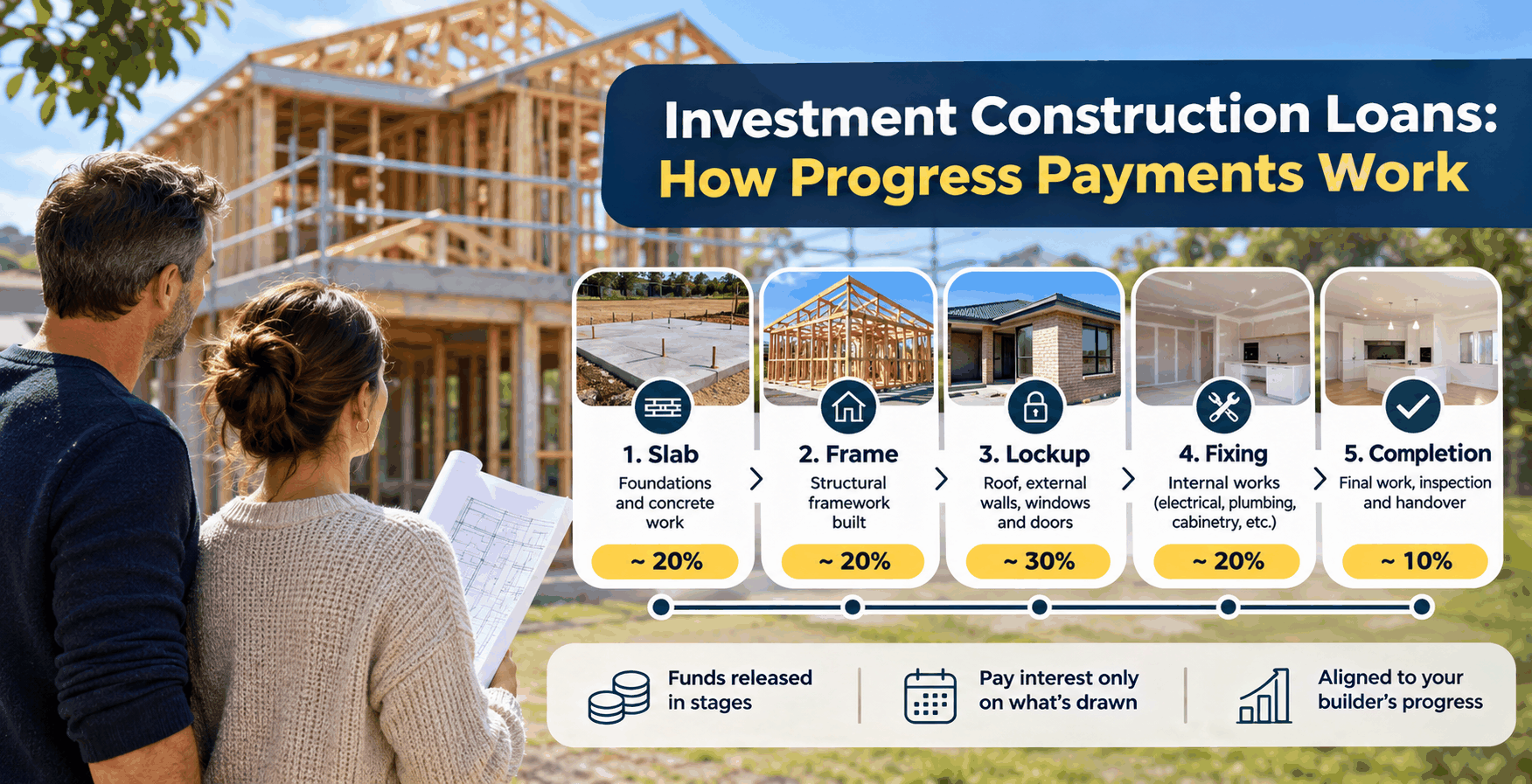
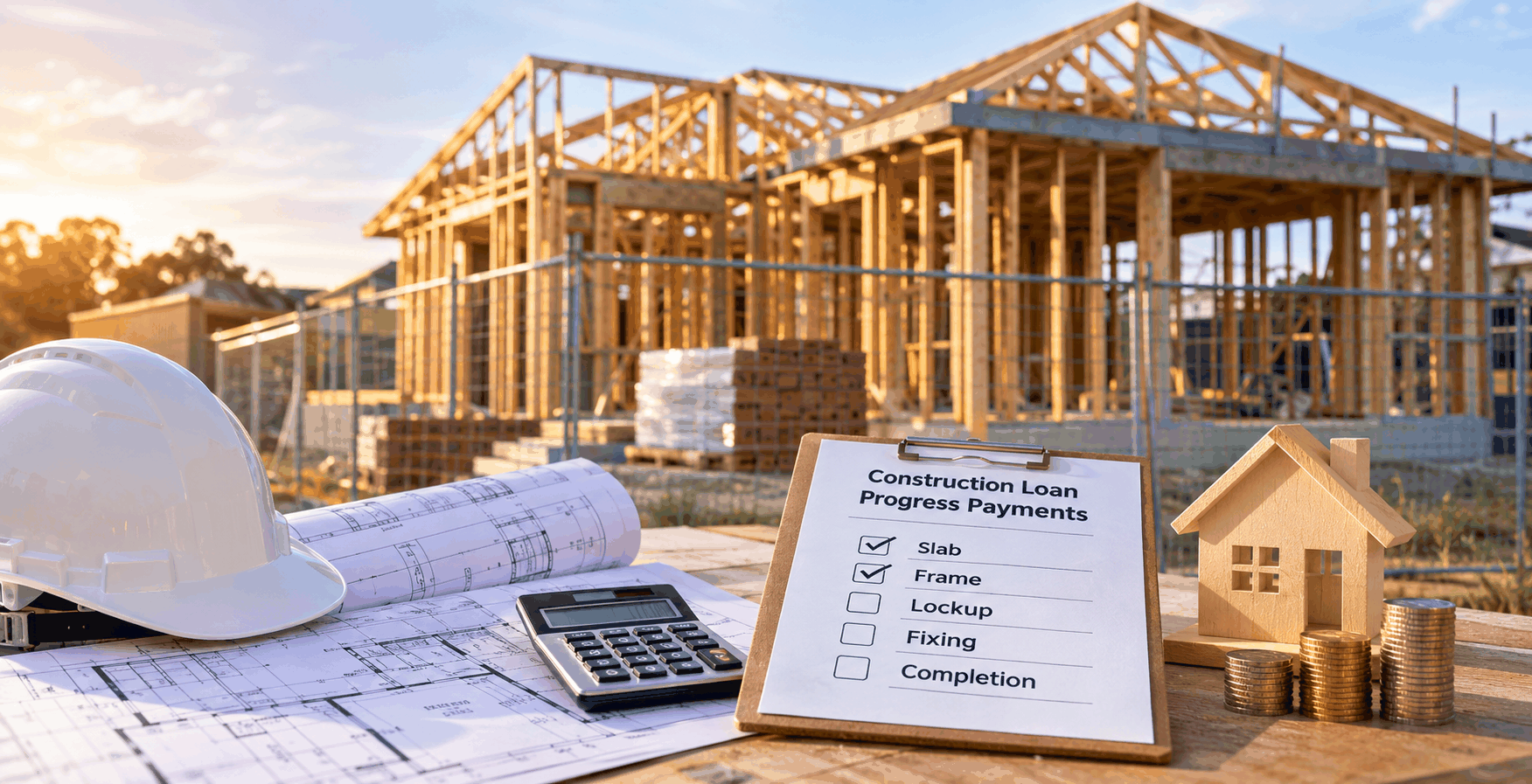
Rather than receiving the entire construction loan amount at settlement, funds are generally released progressively as building work reaches agreed stages.
These payments are commonly called progress payments.
Typical Construction Loan Process
| Stage | What Happens |
|---|---|
| Finance assessment | Lender reviews borrowing capacity, proposed project and supporting documents |
| Land purchase | Investor secures the land and completes required approvals |
| Construction contract | Building contract, plans and valuations are reviewed |
| Progress payments | Approved funds are released as construction milestones are completed |
| Final inspection | Completion documentation and lender requirements are checked |
| Rental commencement | Completed property becomes available for tenants |
Some construction loans offer interest-only payments during the construction period, with interest calculated on the amount drawn.
This can reduce repayments compared with immediately paying interest on the entire approved construction facility.
However, financing structures vary between lenders.
Investors should also consider the tax treatment of construction-period interest.
Under Australian tax rules, interest related to vacant land may be subject to restrictions before a completed residential property becomes legally occupiable and available for rent. Interest attributable to constructing the building may be treated differently.
This means tax deductions during construction should not be assumed without professional advice.
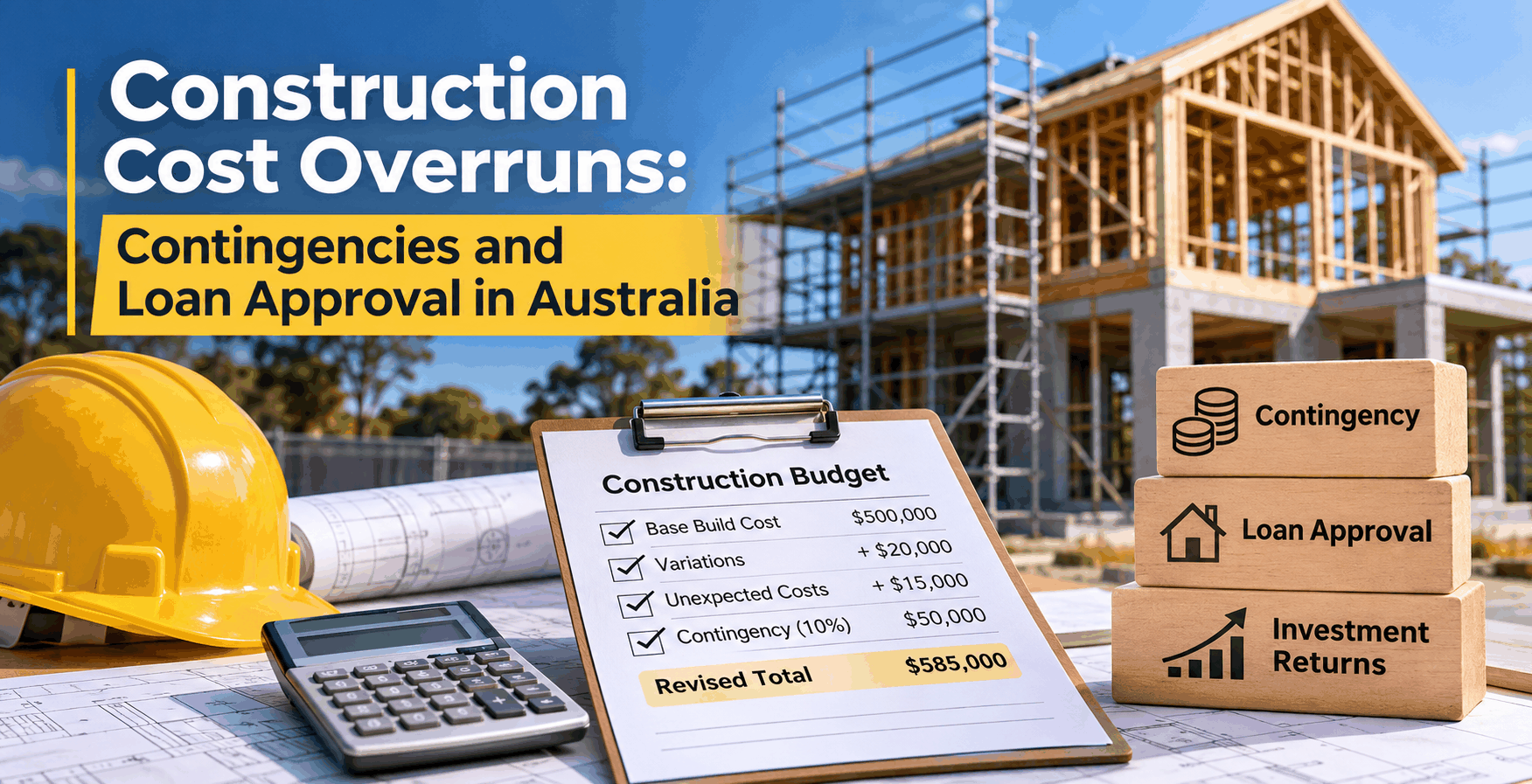
The right construction loan structure should also consider contingency funds, progress-payment timing and possible completion delays.
For investors comparing construction financing with standard investment loans, NMC Finance’s Property Investor Finance service provides guidance on available loan structures and borrowing options.
10. What Are the Risks of Building an Investment Property?
Although constructing a new rental property can offer financial benefits, it introduces additional risks.
Investors should be prepared for the possibility that the project costs more or takes longer than originally expected.
Key Construction Investment Risks
| Potential Risk | Financial Impact | Suggested Consideration |
|---|---|---|
| Construction delays | Additional interest and holding costs | Maintain cash reserves |
| Builder insolvency | Project disruption and possible losses | Review builder credentials and protections |
| Rising construction costs | Higher overall project expenditure | Understand contract exclusions |
| Interest rate increases | Higher repayments | Stress-test loan affordability |
| Lower-than-expected rent | Larger cash-flow shortfall | Obtain independent rental appraisals |
| Extended vacancy | Reduced rental income | Research tenant demand |
| Lower completion valuation | Potential financing shortfall | Understand lender valuation requirements |
| Falling property values | Reduced equity or investment losses | Plan for a long-term holding period |
Investors should avoid making decisions based only on projected capital growth or tax savings.
An investment property should remain financially manageable even if rent is temporarily unavailable or borrowing costs increase.
11. When Buying an Existing Investment Property May Be Better
Despite the advantages of new construction, buying an established investment property may still make sense.
For example, an investor may prefer an existing property when:
- They want rental income to commence sooner.
- They are targeting an established suburb with limited vacant land.
- An existing property offers stronger location fundamentals.
- Construction costs are unusually high.
- They wish to avoid building delays.
- A suitable existing property is available below its assessed market value.
- They already hold investments protected by the negative gearing grandfathering rules.
Established homes can also offer renovation opportunities, although these require careful financial planning.
The objective should not be to build simply because certain tax deductions are available.
Instead, investors should compare the after-tax holding costs, rental return, likely capital expenditure and potential net sale proceeds of each option.
12. Building New vs Buying Existing: Which Strategy Suits Different Investors?
Different investors have different financial priorities.
| Investor Profile | Potentially Suitable Strategy | Why |
|---|---|---|
| Salaried professional seeking tax-efficient investing | Eligible new build | Potential negative gearing and CGT flexibility |
| Investor seeking immediate rental income | Established property | Earlier rental commencement |
| Homeowner using existing equity | Either option | Depends on serviceability and investment objectives |
| Investor prioritising depreciation | New build | Potentially greater qualifying deductions |
| Investor seeking an established inner-city location | Existing property | Greater choice in developed areas |
| Long-term investor comfortable with construction | New build | Design flexibility and potential tax advantages |
| Investor wanting fewer development risks | Established property | Avoids much of the construction process |
For investors purchasing after the May 2026 tax reform cutoff, eligible new residential construction may deserve particular consideration.
However, suitability depends on individual circumstances, not simply the investor category.
13. Frequently Asked Questions About Building vs Buying an Investment Property
Is negative gearing only available for newly built properties in Australia?
Not under the rules currently applying in November 2026. However, from 1 July 2027, salary-offset negative gearing benefits will generally be restricted to eligible new residential properties and grandfathered investments. Established properties acquired after the May 2026 cutoff will generally face restrictions on offsetting rental losses against wages.
Is it better to build an investment property in Australia in 2027?
Building an eligible new investment property may provide advantages through negative gearing, depreciation deductions and CGT flexibility. However, construction costs, rental demand, financing and location must also be evaluated before determining whether it is the better investment.
Do newly constructed investment properties pay less capital gains tax?
Not necessarily. Eligible new residential investment properties will have a choice between the existing 50% CGT discount and the new inflation-adjusted arrangements, subject to applicable rules. The actual tax outcome depends on the investor’s circumstances.
Can negative gearing reduce income tax on my salary?
Yes, where the investor and property qualify. Eligible rental losses may be deducted against employment income, reducing taxable income. This can lower the after-tax cost of holding an investment property, but it does not eliminate the underlying loss.
Can an investment property cost only $143 per week?
A weekly contribution of approximately $143 may be achievable under specific financing, rental and tax assumptions. The illustrative scenario in this article demonstrates how such a result could arise. It is not a guaranteed or typical investment cost.
Are new investment properties eligible for depreciation deductions?
Yes, qualifying new investment properties may provide capital works and plant and equipment depreciation deductions. The amount depends on eligible construction expenditure, asset costs, ownership arrangements and tax rules.
Can I use my home equity to build a rental property?
Potentially. Existing homeowners may be able to use available equity to help finance an investment property. Lender approval depends on valuation, borrowing capacity, serviceability and other lending requirements.
For further information, explore NMC Finance’s investment property financing options.
Is building an investment property cheaper than buying an existing home?
It depends on land values, building expenses, site conditions, transaction costs and location. Building can be more affordable in some markets, while established properties may offer better overall value in others.
Is it better to build or buy your first home in Australia?
The better choice depends on your budget, location, borrowing capacity and eligibility for government assistance. Building a new home may offer greater flexibility and access to certain state-based incentives, while buying established can offer immediate occupancy.
First-time buyers can explore NMC Finance’s first home buyer loan options to compare deposits, borrowing requirements and potential assistance.
Can I claim interest expenses while building an investment property?
Some construction-related interest expenses may qualify for deductions, but the tax treatment differs between vacant land and building construction. Investors should seek tax advice before assuming construction-period interest is deductible.
Is building a new investment property a good long-term wealth strategy?
It can be suitable for investors who have adequate borrowing capacity, a realistic cash-flow plan and a property in a location with sound rental and growth fundamentals. Tax benefits should support, rather than determine, the investment decision.
14. Why Choose NMC Finance for Your Property Investment Strategy?
Building or buying an investment property is a significant financial decision.
The right approach depends not only on property selection but also on how the investment is financed and whether the ongoing costs fit comfortably within your financial circumstances.
At NMC Finance, we help Australian property investors understand their lending options and make informed financing decisions.
Whether you’re investing for the first time, expanding an existing portfolio or exploring the possibility of using equity from your family home, our team can help you assess the financing considerations involved.
Our property investment financing approach focuses on:
Borrowing Capacity Assessment
Understanding how much you may be eligible to borrow based on income, existing commitments and lender criteria.
Investment Loan Comparisons
Exploring available lending options and assessing repayment structures suited to your circumstances.
Equity-Based Investment Finance
Assessing whether available equity in an existing property could assist with your next investment purchase.
Construction Loan Guidance
Understanding construction finance requirements, progressive payments and the funding process involved in building.
Cash-Flow Considerations
Evaluating repayment obligations and investment holding costs before making a long-term financial commitment.
NMC Finance supports buyers at different stages of their property journey.
If you’re preparing to purchase your first home, explore our First Time Home Buyer Loans service for guidance on borrowing power, deposits and home loan options.
If you’re ready to acquire your first rental property or expand an existing portfolio, our Property Investor Finance service can help you understand your investment borrowing options.
We also recommend obtaining independent financial and taxation advice when assessing negative gearing, depreciation and capital gains tax.
Ready to Explore Building Your Next Investment Property?
Australia’s changing property tax rules mean investors have more reasons to evaluate newly constructed residential properties.
For suitable investors, eligible new builds may offer valuable tax flexibility, depreciation opportunities and the potential for long-term wealth creation.
However, getting the financing right is just as important as selecting the property.
Speak with NMC Finance to explore your investment property borrowing options and understand how construction finance could fit into your long-term plans.
Explore Investment Property Loans with NMC Finance
Explore First Time Home Buyer Loans
Disclaimer: This article provides general information only and does not constitute personal financial, investment, taxation or legal advice. Illustrative figures are hypothetical and do not represent guaranteed outcomes or actual client results. Tax benefits depend on eligibility and individual circumstances. Property values and rental income can rise or fall. Readers should seek appropriately qualified advice before making investment or borrowing decisions.