
⏱ Estimated reading time: 17 min read
Building an investment property in Australia can be an effective way to expand your property portfolio, generate rental income and create long-term wealth. However, even a carefully planned construction project can experience unexpected expenses.
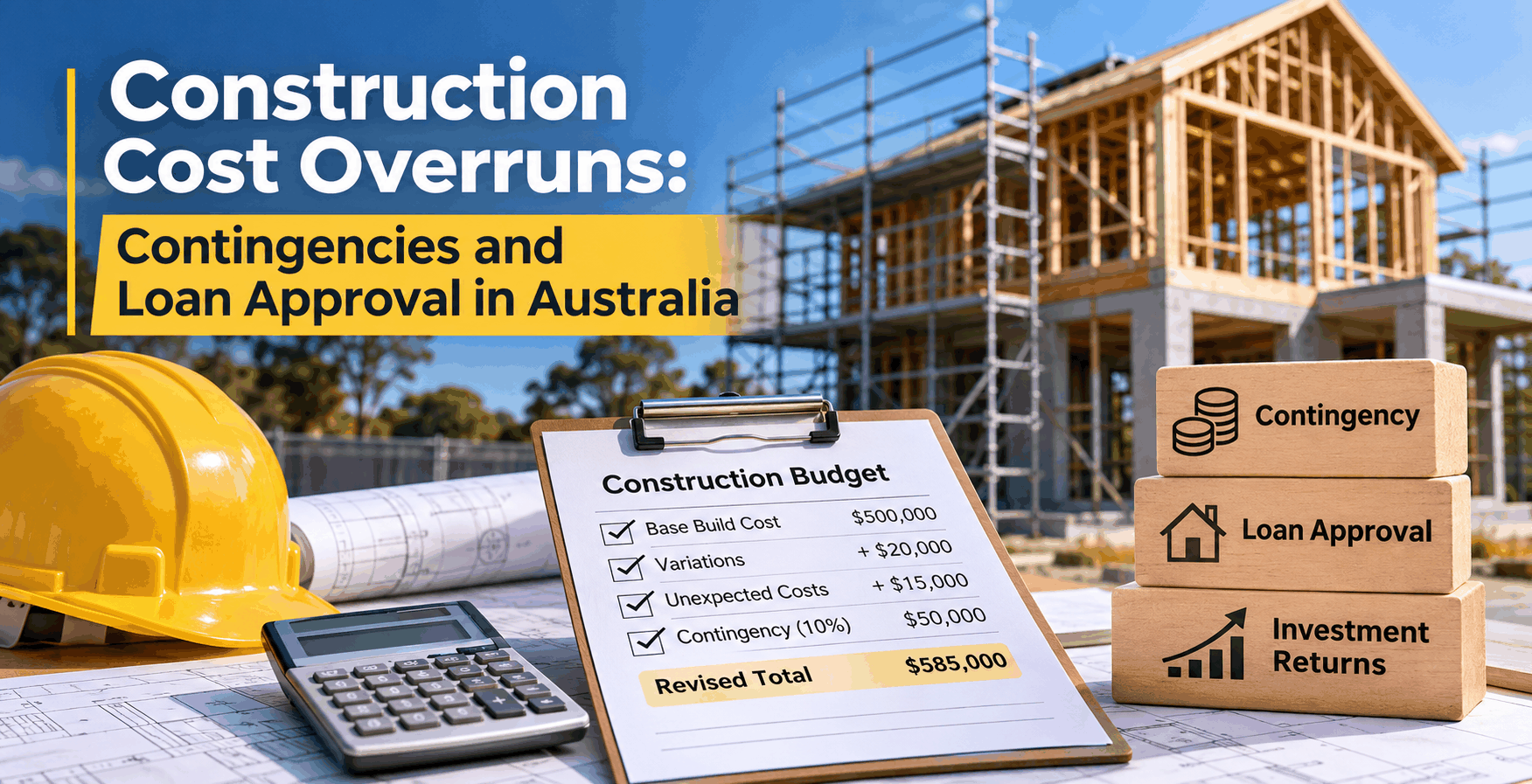
A $500,000 construction project might increase to $540,000 because of unforeseen excavation costs, material upgrades, building variations or delays. For property investors who already have an existing home loan, these additional expenses can affect borrowing capacity, cash flow and overall investment returns.
Construction cost overruns do not automatically increase your approved construction loan. If building expenses exceed the original budget, you may need to use contingency funds, contribute additional savings, access available equity or apply for additional finance.
Understanding how construction cost overruns affect loan approval helps investors prepare for potential financial challenges before construction begins.
Construction Cost Overruns in Australia: Quick Answers
| Common Question | Quick Answer |
|---|---|
| What is a construction cost overrun? | When actual construction expenses exceed the originally planned budget. |
| Will the bank cover additional construction costs? | Not automatically. Additional funding usually requires lender approval. |
| How much construction contingency should I budget? | A 5–10% allowance is a useful planning starting point, but some projects need more. |
| Can I increase my construction loan after approval? | Potentially, subject to borrowing capacity, valuation and lender requirements. |
| What happens if my construction loan runs out? | You may need savings, available equity or additional approved financing. |
| Can I use equity in my existing home? | Potentially, if sufficient usable equity and borrowing capacity exist. |
| Do cost overruns affect investment returns? | Yes. Additional debt, interest and delays can reduce investment cash flow. |
Actual lending criteria and contingency requirements vary by lender and project.
What Are Construction Cost Overruns?
Construction cost overruns occur when the total cost of completing a building project exceeds the original budget.
For example, an investor might sign a building contract for $450,000 but discover that additional drainage, excavation and electrical work are required.
If those changes add $35,000, the revised construction cost increases to $485,000.
For investors, the challenge is not simply paying more for construction. The greater concern is whether those additional expenses can be financed without disrupting the project or compromising the broader investment strategy.
Common Causes of Construction Cost Overruns in Australia
| Cause | Example | Potential Financial Impact |
|---|---|---|
| Unexpected site conditions | Rock excavation, unstable soil or drainage issues | Additional equipment, labour and engineering expenses |
| Building variations | Kitchen upgrades, extra electrical work or design changes | Increased building contract costs |
| Provisional sums | Excavation or foundation work exceeds the original allowance | Additional out-of-pocket expenses |
| Prime cost items | Fixtures and fittings cost more than budgeted | Higher material costs |
| Construction delays | Weather disruptions or labour shortages | Additional interest and holding costs |
| Council requirements | Unexpected compliance or engineering requirements | Additional professional and construction fees |
| Incomplete budgeting | Landscaping, fencing or utility connections excluded | Unexpected completion costs |
Although fixed-price building contracts can reduce uncertainty, they do not necessarily eliminate cost overruns.
Certain expenses may fall outside the original contract, while approved variations can increase the final amount payable.
For property investors, reviewing the entire construction budget before committing to a project is essential.
How Much Construction Contingency Should Australian Investors Budget?
A construction contingency is money allocated to cover unexpected costs during a building project.
For preliminary financial planning, investors may model contingency allowances of 5%, 10% and 15% to understand the potential impact of rising construction expenses.
A 5–10% buffer can be a practical starting point, but the appropriate allowance depends on the project’s complexity, site conditions and level of uncertainty.
There is no universal construction contingency percentage required by every Australian lender. A lender may also include a contingency allowance in its assessment without necessarily making that amount available as additional borrowing.
Construction Contingency Budget Examples
| Construction Budget | 5% Contingency | 10% Contingency | 15% Contingency |
|---|---|---|---|
| $300,000 | $15,000 | $30,000 | $45,000 |
| $400,000 | $20,000 | $40,000 | $60,000 |
| $500,000 | $25,000 | $50,000 | $75,000 |
| $600,000 | $30,000 | $60,000 | $90,000 |
| $750,000 | $37,500 | $75,000 | $112,500 |
| $1,000,000 | $50,000 | $100,000 | $150,000 |
These percentages are illustrative planning scenarios, not guaranteed or universal lender requirements.
For example, an investor planning a $500,000 construction project might establish a $50,000 contingency allowance.
If unexpected costs total $20,000, the investor may be able to cover those expenses without applying for additional borrowing, provided sufficient accessible contingency funds are available.
If additional expenses reach $70,000, the investor would face a $20,000 shortfall beyond the original contingency.
This is why construction contingency planning should be considered alongside borrowing capacity, existing mortgage obligations and anticipated rental income.
For investors seeking to structure their borrowing around long-term portfolio growth, explore NMC Finance’s property investment loan solutions.
Does a Construction Loan Automatically Cover Cost Overruns?
No. An approved construction loan generally has a defined lending limit based on the original construction budget, property valuation and borrower’s financial circumstances.
If construction expenses increase, the lender does not automatically increase the approved loan amount.
An investor may need to contribute additional savings, use available contingency funds or apply for further lending.
Example: A $500,000 Construction Project Goes Over Budget
| Financial Item | Original Plan | Revised Position |
|---|---|---|
| Building contract | $500,000 | $500,000 |
| Unexpected site expenses | $0 | $20,000 |
| Building variations | $0 | $15,000 |
| Additional holding costs | $0 | $10,000 |
| Total construction-related costs | $500,000 | $545,000 |
| Approved construction loan | $400,000 | $400,000 |
| Original borrower contribution | $100,000 | $100,000 |
| Additional funds required | $0 | $45,000 |
Illustrative example assuming no separate contingency or additional available funds.
The investor now needs an additional $45,000 to complete the project and cover the additional holding expenses.
Potential funding solutions may include personal savings, available property equity, an approved loan increase or adjustments to the remaining construction budget.
However, any additional borrowing depends on lender assessment.
What Happens When Construction Costs Exceed the Approved Loan?
If building expenses exceed the approved construction loan and available borrower funds, investors should identify the funding shortfall as early as possible.
Waiting until a builder requests additional payment can create unnecessary pressure and potentially interrupt construction.
Five Steps to Manage a Construction Loan Budget Shortfall
Step 1: Confirm the additional expenses
Request a detailed breakdown from the builder explaining the cost increase, including variations, materials, labour and revised completion dates.
Step 2: Recalculate the remaining construction budget
Establish the amount still required to complete construction, including outstanding progress payments, approved variations, professional fees and holding costs.
Step 3: Review available contingency funds
Determine whether accessible savings or previously allocated contingency funds can cover part or all of the shortfall.
Step 4: Discuss additional funding options
Consult your mortgage broker or lender about the possibility of increasing the construction loan, accessing usable equity or considering alternative financing arrangements.
Step 5: Confirm finance before committing to additional work
Where possible, avoid approving discretionary variations until the additional expense can be funded.
A practical calculation is:
Funding Shortfall = Remaining Cost to Complete − Available Undrawn Loan Funds − Accessible Borrower Funds
For example:
- Remaining construction costs: $180,000
- Available undrawn construction loan: $130,000
- Accessible borrower funds: $20,000
- Remaining funding shortfall: $30,000
Identifying this gap early gives investors more time to explore possible solutions.
Can You Increase a Construction Loan After Approval?
Australian property investors may be able to apply for additional construction finance after their original loan has been approved.
However, a construction loan top-up is not guaranteed.
The lender may need to reassess borrowing capacity, available security, property valuation and the revised construction budget.
What Lenders Consider When Assessing Additional Construction Finance
| Assessment Factor | What the Lender Reviews | Why It Matters |
|---|---|---|
| Borrowing capacity | Income, expenses, liabilities and existing repayments | Determines ability to service additional debt |
| Property valuation | Estimated completed property value | Determines available lending security |
| Loan-to-value ratio | Borrowing compared with security value | Helps establish acceptable lending limits |
| Construction budget | Revised costs and remaining expenses | Confirms the amount required to complete |
| Builder and contract | Approved variations, contract terms and completion plans | Helps establish project feasibility |
| Existing equity | Available equity in the project or other properties | May support additional borrowing |
| Credit position | Credit history and current commitments | Helps assess lending eligibility |
For example, an investor with substantial equity in an existing property may have sufficient security to request additional finance.
However, if their income cannot support higher repayments under the lender’s assessment, approval may still be declined.
Similarly, sufficient income does not necessarily overcome an inadequate property valuation.
Can You Refinance a Construction Loan Midway Through the Build?
Refinancing may be possible, but arranging finance on an unfinished property can be more complex than refinancing an established home.
A new lender may require updated valuations, construction documentation, builder information and confirmation of the remaining cost to complete.
Investors should also consider refinancing expenses and any differences in interest rates or loan conditions.
The most appropriate option depends on the individual project and financial circumstances.
What Happens if Construction Costs Exceed the Bank Valuation?
Construction loan valuations generally consider the estimated market value of the completed property.
This is often referred to as an as-if-complete valuation.
The lender’s valuation may differ from the combined cost of purchasing land and constructing the property.
For example, an investor may spend $850,000 on a project, while the lender determines that the completed property will be worth $800,000.
This difference can affect how much the lender is prepared to advance.
Example: Construction Loan Valuation Shortfall
| Financial Item | Expected Valuation | Lower Valuation |
|---|---|---|
| Total project cost | $850,000 | $850,000 |
| Completed property valuation | $850,000 | $800,000 |
| Illustrative loan-to-value ratio | 80% | 80% |
| Maximum loan at assumed LVR | $680,000 | $640,000 |
| Borrower contribution required | $170,000 | $210,000 |
| Additional funds required | — | $40,000 |
Illustrative only. Actual borrowing may be lower based on lender policy, serviceability and other conditions.
A $50,000 reduction in valuation could reduce the available loan by $40,000 at an assumed 80% loan-to-value ratio.
This highlights why investors should consider both the proposed construction costs and the property’s likely completed market value.
A higher building budget does not necessarily translate into an equivalent increase in property value.
Can You Use Equity in Your Existing Home to Cover Construction Cost Overruns?
For Australians building a second property as an investment, existing home equity may provide another potential funding option.
Home equity is the difference between a property’s market value and the outstanding mortgage secured against it.
However, the amount that may be available to borrow is often less than the total equity.
Example: Calculating Usable Home Equity
| Financial Item | Amount |
|---|---|
| Existing property value | $1,000,000 |
| Outstanding mortgage | $550,000 |
| Total property equity | $450,000 |
| Illustrative maximum borrowing at 80% LVR | $800,000 |
| Less existing mortgage | $550,000 |
| Potential usable equity | $250,000 |
This calculation illustrates potential security-based borrowing capacity, not an approved loan or guaranteed available funds.
In this example, the investor may have enough potential usable equity to explore financing a $40,000 construction shortfall.
However, additional borrowing would remain subject to lender approval, financial assessment and suitable security arrangements.
Should Property Investors Use Home Equity for Construction?
Using equity can potentially help investors complete a construction project while preserving some cash savings.
However, it also increases total borrowing and repayment obligations.
If the additional debt is secured against the family home, the investor should carefully consider the resulting financial exposure.
It is important to assess whether the property investment remains financially sustainable if interest rates increase, construction is delayed or rental income falls below expectations.
NMC Finance can help investors explore property investment finance options in the context of their existing mortgage commitments and longer-term portfolio objectives.
How Construction Cost Overruns Affect Investment Property Cash Flow
Construction cost overruns can reduce the financial performance of an investment property.
Additional borrowing increases repayment obligations, while construction delays can extend the period before rental income begins.
For investors who already have an existing mortgage, this can place additional pressure on household cash flow.
Example: Additional Loan Repayments After a Construction Overrun
Assume an investor originally planned to borrow $650,000 but needs an additional $40,000.
| Financial Item | Original Loan | Revised Loan |
|---|---|---|
| Loan amount | $650,000 | $690,000 |
| Illustrative interest rate | 6.5% p.a. | 6.5% p.a. |
| Loan term | 30 years | 30 years |
| Approximate monthly repayment | $4,108 | $4,361 |
| Additional monthly repayment | — | $253 |
| Additional annual repayments | — | $3,036 |
Illustration assumes principal-and-interest repayments, a constant interest rate and monthly repayment calculations. Actual loan arrangements vary.
An additional $40,000 loan could increase monthly repayments by approximately $253 under these assumptions.
Although this may seem relatively modest, it reduces the rental income available after financing costs.
What Happens if Construction Is Delayed?
Suppose a newly built investment property was expected to generate $650 per week in rent.
If construction is delayed by approximately 13 weeks, the investor may experience around $8,450 in deferred gross rental income.
Additional interest and holding expenses can further affect the investment’s financial performance.
Construction delays should therefore be considered alongside direct building cost overruns.
Fixed-Price Building Contracts: Are Investors Fully Protected?
A fixed-price building contract can provide greater certainty over construction costs.
However, investors should not assume that the contract covers every possible expense.
Variations, provisional sums, prime cost allowances and excluded works can increase the amount ultimately payable.
Understanding Common Building Contract Terms
| Contract Term | Meaning | Potential Risk |
|---|---|---|
| Fixed-price contract | Agreed price for clearly defined construction works | Excluded items and permitted variations may increase costs |
| Prime cost item | Allowance for fixtures or fittings not yet selected | Final selections may exceed the allowance |
| Provisional sum | Estimated amount for work where costs are not yet known | Actual expenses may exceed the estimate |
| Contract variation | Approved change to the original scope or specifications | May increase the contract price and project duration |
For example, a construction contract may include a $12,000 provisional sum for excavation.
If unexpected site conditions increase the final excavation expense to $24,000, the difference may become an additional cost, depending on the contract terms.
Investors should review contract allowances and exclusions carefully before signing.
Obtaining appropriate building, legal and financial advice can help identify risks before construction begins.
How to Prevent Construction Cost Overruns Before Building
While some construction expenses are unavoidable, careful financial and project planning can reduce the likelihood of major budget surprises.
Construction Cost Overrun Prevention Checklist
| Recommended Action | Why It Matters |
|---|---|
| Obtain detailed building quotations | Helps establish a realistic project budget |
| Review soil and site reports | Identifies potential excavation or foundation expenses |
| Confirm council requirements | Reduces unexpected approval or compliance costs |
| Review contract exclusions | Clarifies expenses outside the agreed construction price |
| Limit unnecessary variations | Helps control discretionary spending |
| Establish an appropriate contingency | Provides a buffer against unexpected expenses |
| Confirm lender requirements | Clarifies financing conditions before construction |
| Stress-test repayment affordability | Assesses the impact of additional debt |
| Allow for rental income delays | Helps protect investment cash flow |
Investors may also benefit from developing multiple budget scenarios rather than relying on a single construction estimate.
Three Construction Budget Scenarios Every Property Investor Should Consider
The following examples demonstrate how even relatively modest cost increases can affect a construction investment.
| Financial Item | Original Budget | Moderate Overrun | Significant Overrun |
|---|---|---|---|
| Construction budget | $500,000 | $500,000 | $500,000 |
| Additional building costs | $0 | $25,000 | $60,000 |
| Additional holding costs | $0 | $5,000 | $15,000 |
| Revised total costs | $500,000 | $530,000 | $575,000 |
| Total overrun | $0 | $30,000 | $75,000 |
| Overrun percentage | 0% | 6% | 15% |
For a $500,000 project, a 6% overrun represents an additional $30,000.
A more substantial 15% overrun increases the project cost by $75,000.
Before proceeding, investors should ask whether they could fund either scenario without compromising their existing mortgage commitments or financial reserves.
If the answer is no, revisiting the construction budget, project scope or borrowing arrangements before building may be worthwhile.
Why Construction Loan Planning Matters for Long-Term Property Investors
When building an investment property, construction finance should form part of a broader investment strategy.
For investors who already own a principal residence or multiple properties, the decision to borrow additional funds can influence future borrowing capacity and investment flexibility.
Higher construction expenses may affect cash flow, debt levels and the amount of capital available for subsequent property purchases.
This is why investors should consider the construction budget alongside expected rental returns, existing repayments, interest-rate sensitivity and longer-term portfolio objectives.
A financing arrangement that appears affordable at the beginning of a project should also remain manageable if construction costs increase or completion takes longer than expected.
For investors exploring their next property purchase, NMC Finance’s Property Investor Loans can help provide a starting point for understanding available financing options.
Why Choose NMC Finance for Investment Construction Loans?
At NMC Finance, we understand that building an investment property involves more than securing the initial construction loan.
It requires a finance strategy that considers construction expenses, existing mortgage commitments, potential rental income and future investment objectives.
Whether you are planning your first rental property or expanding an established property portfolio, understanding your borrowing options can help you make more informed decisions.
How NMC Finance Can Help
Explore suitable construction lending options
Understand the lending arrangements available for investment property construction and how different lenders may assess applications.
Review borrowing capacity and existing property equity
Explore whether your financial position and available security may support your proposed investment.
Plan for potential construction cost increases
Consider contingency requirements, additional borrowing scenarios and the potential financial impact of construction delays.
Assess investment property financing structures
Review lending options in the context of your existing home loan, investment objectives and repayment commitments.
Understand additional funding requirements
If construction costs increase, discuss possible financing options and the lender assessment process.
NMC Finance helps property investors explore their financing options with their broader investment goals in mind.
Planning to build an investment property in Australia?
Explore NMC Finance’s Property Investment Loan Solutions and discuss the financing options that may suit your circumstances.
Frequently Asked Questions About Construction Cost Overruns in Australia
1. What happens if my construction loan runs out before the house is finished?
If the approved loan funds and available borrower contributions are insufficient to complete construction, you may need to use savings, access available equity or request additional finance. Your lender may require an updated construction budget and cost-to-complete assessment before approving further funding.
2. How much contingency should I have for a construction loan in Australia?
Investors can use 5–10% of construction costs as an initial planning scenario, although projects with greater uncertainty may require more. The appropriate allowance depends on site conditions, contract terms, building complexity and lender requirements.
3. Can I borrow more if my construction costs increase?
Potentially. You may be able to request a construction loan increase or explore alternative finance arrangements. Approval depends on borrowing capacity, property valuation, security and lender policy.
4. Does a fixed-price building contract prevent construction cost overruns?
No. Although fixed-price contracts provide greater certainty for agreed works, contract variations, excluded expenses, prime cost allowances and provisional sums can create additional costs.
5. What happens if the bank valuation is lower than construction costs?
A lower completed-property valuation may reduce the amount available to borrow. You may need to contribute additional savings, provide acceptable security or reconsider the project budget and financing structure.
6. Can I use equity in my existing home to cover construction overruns?
Potentially. If sufficient usable equity is available and you meet the lender’s requirements, additional secured borrowing may be possible. However, this increases total debt and financial exposure.
7. Will construction cost overruns affect loan approval?
They can. A lender may reassess the revised building budget, borrowing capacity, security value and remaining costs before approving additional funding. An increase in the original loan amount is not guaranteed.
8. What happens if my builder requests additional payment for variations?
Request written details of the proposed variation and confirm whether it is permitted under the building contract. Before agreeing to the expense, establish how it will be funded and whether lender approval is required.
9. Are construction cost overruns tax-deductible for investment properties?
Not automatically. The tax treatment depends on the nature of the expenditure and relevant Australian tax rules. Certain construction costs may be capital in nature, while eligible capital works may qualify for deductions over time. Investors should obtain qualified taxation advice.
10. Can construction delays affect investment property profitability?
Yes. Construction delays may increase interest and holding costs while postponing rental income. This can reduce investment cash flow and affect anticipated returns.
11. Is it better to use savings or borrow more to cover construction overruns?
The appropriate choice depends on your available savings, borrowing costs, emergency reserves and financial objectives. Using savings may avoid additional interest, while borrowing can preserve liquidity but increase repayment obligations.
12. When should I speak to a mortgage broker about construction cost overruns?
Ideally, before signing the building contract. If construction is underway and unexpected costs arise, discussing the situation early can help clarify available funding options before the project faces a significant shortfall.
Final Thoughts: Protect Your Construction Budget and Investment Strategy
Construction cost overruns are a financial risk for Australians building investment properties.
Unexpected site conditions, building variations, project delays and valuation differences can increase the amount required to complete construction.
For investors who already have a home loan, these additional costs can also affect borrowing capacity, cash flow and future investment opportunities.
The most effective approach combines a realistic construction budget, appropriate contingency planning, careful contract review and a suitable financing strategy.
Most importantly, an approved construction loan does not automatically increase when building costs rise.
Understanding potential funding shortfalls before they arise can help investors make informed decisions and reduce the risk of avoidable construction delays.
If you are planning to build an investment property or are concerned about unexpected construction expenses, reviewing your lending options early can help you understand the next steps.
Build Your Investment Property With a Clearer Finance Strategy
Speak to NMC Finance About Property Investment Loans to explore your construction finance options, borrowing capacity and potential investment lending arrangements.
Disclaimer: This article provides general information only and does not constitute personal financial, legal or taxation advice. All examples are illustrative and do not represent lending offers or guarantees. Loan approval is subject to individual lender requirements, financial assessment and applicable terms and conditions. Seek professional advice appropriate to your circumstances.