
⏱ Estimated reading time: 19 min read
Buying an investment property can be an important step towards building long term wealth. Whether you’re looking to generate rental income, benefit from potential capital growth or gradually build a property portfolio, the right investment can support your broader financial goals.
But before you start comparing properties, attending inspections or speaking with real estate agents, there’s one question worth answering.
Can I actually afford an investment property?
It’s a question many Australians ask, particularly when they already have a mortgage, family expenses or other financial commitments.
The answer isn’t always as straightforward as looking at your salary or checking how much a bank might lend you.
You might earn a comfortable income but have limited savings. You might have considerable equity in your existing home but find that your borrowing capacity is restricted by other commitments. Or you might qualify for an investment property loan but struggle with the ongoing costs once you’ve purchased.
Being financially ready to invest means understanding the complete picture.
That includes your income, existing debts, available deposit, borrowing capacity, expected rental income and how the property will affect your household finances.
This guide will help you assess whether buying an investment property is realistic for your circumstances, what to consider before applying for finance and how to establish a comfortable purchase budget.
Can I Afford an Investment Property in Australia?
You may be able to afford an investment property if you have sufficient funds to complete the purchase, can qualify for suitable finance and can comfortably manage the property’s ongoing expenses alongside your existing financial commitments.
There are three questions to consider.
1. Can you afford the deposit and purchase costs?
You’ll need to establish how much money is required upfront and whether those funds will come from savings, usable equity or a combination of both.
2. Can you qualify for an investment property loan?
Lenders assess income, debts, living expenses, credit history and other factors when determining whether you can support additional borrowing.
3. Can you afford to hold the property?
Even after your loan is approved, you’ll need to manage repayments, maintenance, insurance, property management fees and possible periods without rental income.
All three considerations matter.
A buyer might have enough money for a deposit but insufficient borrowing capacity. Another might qualify for a substantial loan but lack the savings needed for settlement.
The objective is to find a property budget that works across your entire financial position, not simply the highest purchase price a lender might approve.
1. Understand Your Current Financial Position
Before considering another mortgage, start by understanding how much money your household earns and spends.
This might sound straightforward, but many people underestimate their regular expenses.
A household earning $180,000 annually may appear well positioned to purchase an investment property. However, an existing mortgage, childcare, vehicle repayments and other commitments can significantly reduce the amount available for another investment.
Start with your combined monthly income after tax.
Include employment income, reliable business income and other recurring income sources.
Next, calculate your regular expenses.
These might include:
- Your existing mortgage or rent
- Groceries and household expenses
- Electricity, gas, water and internet
- Childcare and school fees
- Vehicle repayments and transport
- Insurance premiums
- Credit card and personal loan repayments
- Medical and other family expenses
- Entertainment and discretionary spending
- Regular savings contributions
Reviewing three to six months of bank statements can help establish a more realistic spending pattern.
Don’t forget expenses that occur quarterly or annually.
For example, vehicle registration, insurance renewals, holidays and school expenses might not appear in a typical monthly budget.
Example: Assessing Your Monthly Household Surplus
Consider a couple with the following financial position.
| Financial item | Monthly amount |
|---|---|
| Combined household income after tax | $13,000 |
| Existing home loan repayment | $3,500 |
| Household living expenses | $4,200 |
| Other loan repayments | $600 |
| Regular savings and planned expenses | $1,200 |
| Remaining available surplus | $3,500 |
The couple has approximately $3,500 remaining each month after allowing for their current spending and savings commitments.
That doesn’t mean they should automatically spend the entire $3,500 on an investment property.
They may want to retain some financial flexibility for unexpected expenses, travel, family requirements or changes in employment.
A more useful question is:
How much of our monthly surplus would we feel comfortable contributing towards an investment property over the next five to ten years?
The answer will vary between households.
Someone with stable employment, minimal existing debt and substantial savings may be comfortable with a different commitment from a family expecting higher childcare costs or a reduction in income.
2. Find Out How Much You Could Borrow
Your borrowing capacity is one of the most important factors in determining whether you can purchase an investment property.
It represents the amount a lender may be prepared to lend based on your financial circumstances and its lending criteria.
However, borrowing capacity isn’t determined by income alone.
Australian lenders generally consider:
- Employment and income stability
- Existing mortgages and other debts
- Household living expenses
- Credit card limits and repayment commitments
- Dependants and family circumstances
- Available deposit or property equity
- Expected rental income
- The proposed loan amount and repayment structure
Lenders also assess whether you could manage repayments at a higher interest rate.
For example, under APRA’s serviceability requirements for regulated banks, lenders generally apply an interest rate buffer of at least 3 percentage points when assessing mortgage repayment capacity.
This means your borrowing capacity may be lower than a simple calculation based on the current advertised interest rate suggests.
Why Borrowing Capacity Differs Between Lenders
Two banks may assess the same applicant differently.
One lender may recognise certain employment income differently from another. There can also be differences in how rental income, bonuses, overtime, business income and existing debts are assessed.
This is particularly relevant for property investors who already own one or more properties.
An investor with considerable equity might still find that their existing mortgages affect their capacity to borrow again.
A borrowing assessment can help establish a realistic starting point before you begin searching for properties.
For a detailed explanation of how banks calculate borrowing capacity, read our guide to How Lenders Assess Investment Loan Serviceability.
You can also explore NMC Finance’s property investor loan solutions to understand the borrowing options available for your circumstances.
3. Work Out How Much Deposit You’ll Need
A deposit is the portion of the purchase price that isn’t covered by the main investment property loan.
Many investors aim for a 20% deposit because it may help them avoid lenders mortgage insurance and access a wider choice of loan products.
However, some lenders may consider smaller deposits, depending on the applicant and property.
For example, consider purchasing an investment property for $700,000.
| Deposit scenario | Deposit amount | Purchase loan |
|---|---|---|
| 20% deposit | $140,000 | $560,000 |
| 15% deposit | $105,000 | $595,000 |
| 10% deposit | $70,000 | $630,000 |
These figures exclude purchasing costs and any applicable lenders mortgage insurance.
A smaller deposit may make it possible to purchase sooner, but it also generally means borrowing more.
That can increase mortgage repayments and total interest costs.
Don’t Forget the Additional Purchase Expenses
The deposit isn’t the only upfront expense.
Depending on the property and location, you may also need to budget for:
- Stamp duty or transfer duty
- Conveyancing and legal fees
- Building and pest inspections
- Government registration charges
- Loan establishment fees
- Lenders mortgage insurance, where applicable
- Adjustments for council rates and other charges
Purchase costs differ across Australian states and territories.
For example, the stamp duty payable on an investment property in New South Wales may differ from the amount payable on a similarly priced property in Queensland, Victoria or South Australia.
Always calculate the actual costs for your proposed purchase rather than relying on a general estimate.
Can You Use Equity Instead of Savings?
Potentially.
If you already own a home, you may have equity available that could help fund an investment property deposit.
Equity is the difference between your property’s current value and the amount owing on the mortgage.
However, not all equity is necessarily available to borrow.
Lenders assess how much equity may be released based on their valuation, lending policies and your ability to repay the additional debt.
For example, someone with a home valued at $1 million and an outstanding mortgage of $500,000 may have usable equity available.
Accessing that equity generally involves additional borrowing.
It can therefore increase your total debt and repayment obligations.
For a detailed comparison, see Investment Property Deposit vs Usable Equity: Funding the Purchase.
4. Estimate How Much Rental Income the Property Could Generate
Rental income is an important part of investment property affordability.
A property generating consistent rental income may reduce the amount you need to contribute from your personal earnings.
However, it’s important to use realistic estimates.
Suppose you’re considering a property expected to rent for $650 per week.
Your gross rental income would be:
$650 multiplied by 52 weeks = $33,800 annually.
That’s approximately $2,817 per month.
But this is income before property expenses and any periods without tenants.
A useful starting point is to investigate comparable rental listings, recent leasing activity and the property’s suitability for local tenants.
Consider whether the advertised rent reflects current market conditions.
You should also allow for the possibility that the property may not remain tenanted throughout the year.
Don’t Base Affordability on Optimistic Rent
It’s tempting to assume that rental income will increase steadily over time.
However, rents don’t necessarily rise every year.
Local supply, tenant demand, economic conditions and tenancy legislation can influence the amount you can charge.
For your initial affordability assessment, use a conservative rental estimate rather than relying on future increases to make the property financially manageable.
5. Calculate the Monthly Cost of Owning the Investment
One of the most common mistakes investors make is comparing rental income only with mortgage repayments.
An investment property involves additional ownership expenses that can affect its financial performance.
Let’s consider a practical example.
You purchase an investment property for $700,000 with a $560,000 principal and interest loan.
Assume an illustrative interest rate of 6% and a 30 year loan term.
Your monthly mortgage repayment would be approximately $3,357.
The property is expected to generate $650 per week in rent.
| Monthly cash flow | Amount |
|---|---|
| Gross rental income | $2,817 |
| Mortgage repayment | $3,357 |
| Property management | $197 |
| Council and water charges | $200 |
| Insurance | $100 |
| Maintenance allowance | $200 |
| Estimated monthly cash shortfall | $1,237 |
This simplified example excludes some possible expenses, tax implications and vacancy periods.
Based on these assumptions, you would need to contribute approximately $1,237 per month from other income.
The next question is whether that amount comfortably fits your household budget.
If your available surplus is $3,500 each month, the investment may leave room for other financial commitments.
If your surplus is only $1,300, the purchase may leave very little margin for unexpected expenses.
Neither figure establishes whether the property is a good investment.
But the comparison helps reveal how the borrowing would affect your day to day finances.
For a more complete breakdown, read Investment Property Holding Costs: Cash Buffers and Vacancies.
6. Understand the Difference Between Affordability and Profitability
A property can be affordable to hold without necessarily being profitable.
Likewise, an investment with strong long term potential may create short term cash flow pressure.
These are different considerations.
Affordability focuses on your ability to meet the financial commitments.
Profitability considers the investment’s financial returns after relevant costs, including rental income and changes in property value.
For example, an investor might comfortably contribute $1,000 per month towards a property.
That doesn’t automatically make the investment attractive.
Its purchase price, rental prospects, condition, location, future expenses and potential resale value still require careful assessment.
Property values can increase or decrease, and capital growth isn’t guaranteed.
It’s important to evaluate the property’s investment merits separately from whether you can obtain finance.
7. Consider Your Financial Plans Over the Next Five Years
Your current financial position is only one part of the affordability decision.
Think about how your household circumstances might change.
You may be planning to start a family, reduce working hours, change careers, launch a business or purchase a larger family home.
Any of these decisions could affect the amount available for investment property expenses.
For example, a couple with two full time incomes may comfortably manage additional borrowing today.
If one person plans to take extended parental leave, the household might need to rely on one income for a period.
The investment should ideally remain manageable without requiring every future financial decision to revolve around meeting the mortgage.
Consider whether your proposed purchase leaves enough flexibility to accommodate your personal plans.
8. Prepare for Unexpected Financial Events
Every investment carries some uncertainty.
With property, unexpected expenses can include urgent repairs, prolonged vacancies, insurance excess payments and changes in mortgage repayments.
Your own circumstances might also change.
Maintaining accessible savings can help you manage these situations without immediately relying on additional borrowing.
There isn’t one cash reserve amount suitable for every investor.
A household with stable income and a relatively new property may have different requirements from a self employed investor purchasing an older house.
A useful approach is to calculate how much money you’d need to cover the property’s expenses for several months without rental income.
Then consider whether you have enough additional savings to manage personal emergencies.
Your investment property buffer shouldn’t be confused with your ordinary household emergency savings.
Both may be needed.
9. What Happens if Interest Rates Increase?
Interest rates can significantly affect investment property affordability.
A property that fits comfortably within your budget at one interest rate may become more expensive to hold if borrowing costs increase.
For illustration, consider a $560,000 principal and interest loan over 30 years.
| Interest rate | Approximate monthly repayment |
|---|---|
| 5% | $3,006 |
| 6% | $3,357 |
| 7% | $3,726 |
| 8% | $4,109 |
These calculations assume the stated interest rate applies over the calculation period.
Moving from 6% to 8% increases the repayment by approximately $752 per month.
That’s more than $9,000 in additional annual repayments.
If you’re already contributing money to cover a rental property’s expenses, higher borrowing costs could place additional pressure on your household.
Before committing to a purchase, consider how you would manage repayments under different interest rate scenarios.
Our guide to Interest Rate Stress Test for an Investment Property Loan explains how to evaluate that risk in more detail.
10. Does Negative Gearing Make an Investment Property More Affordable?
Negative gearing is often discussed when Australians consider investment property.
Broadly, a property is negatively geared for tax purposes when eligible deductible expenses exceed its assessable rental income.
Depending on the applicable tax rules and individual circumstances, the resulting rental loss may provide tax benefits.
However, tax deductions don’t eliminate the financial cost of owning a property.
If you need to contribute $12,000 in cash towards your investment over a year, you still need sufficient funds to meet those payments.
Your tax position may influence the after tax cost, but it shouldn’t be the only reason you consider a purchase affordable.
The treatment of interest, capital repayments, depreciation and other property expenses can also differ.
Tax legislation and eligibility requirements may change.
A qualified accountant or tax adviser can help you understand how the applicable rules affect your circumstances.
It’s generally sensible to establish whether you can manage the investment before relying on possible tax benefits.
11. Can You Afford an Investment Property if You Already Have a Mortgage?
Yes, potentially.
Many Australian property investors purchase additional properties while continuing to repay their family home.
However, existing mortgage commitments influence your borrowing capacity and total household repayments.
Suppose you have a $450,000 mortgage on your home.
You want to borrow another $550,000 to purchase an investment property.
Your total mortgage debt would increase to $1 million.
The lender would consider both loans, along with other liabilities, income and expenses.
The expected rental income may contribute to the assessment, but it doesn’t automatically offset the new mortgage in full.
You should also consider whether your existing home loan could become more expensive if interest rates change.
A realistic affordability assessment needs to account for your entire debt position.
12. Can First Time Property Investors Afford to Buy?
You don’t necessarily need to own your family home before purchasing an investment property.
Some Australians choose to invest while continuing to rent where they live.
This approach is sometimes referred to as rentvesting.
It may appeal to people who prefer to live in a particular suburb but are considering buying an investment property in a different area.
However, the financial assessment is still important.
You’ll need to manage your own rent alongside the investment loan and property expenses.
Your deposit, borrowing capacity and household financial commitments will influence what’s possible.
There may also be differences in eligibility for certain first home buyer benefits when purchasing an investment rather than a home to occupy.
Those requirements vary by scheme and jurisdiction.
Review the applicable rules before deciding whether to buy an investment property as your first property purchase.
13. Five Signs You May Be Ready to Buy an Investment Property
Financial readiness doesn’t mean having unlimited savings or no existing debt.
It means having a clear understanding of your financial position and the risks you’re prepared to manage.
Here are five positive indicators.
You have a consistent household surplus.
You know what you earn and spend, and you have money available after meeting your existing commitments.
You understand your borrowing capacity.
You’ve obtained an indicative assessment and know the approximate purchase budget you may be able to support.
You can fund the deposit and purchase costs.
You have a realistic plan for using savings, equity or other acceptable funds without ignoring the additional debt involved.
You can manage the ongoing expenses.
You’ve calculated the likely monthly contribution required after rental income and operating costs.
You have accessible financial reserves.
You have considered vacancies, repairs, interest rate changes and possible interruptions to household income.
Meeting these conditions doesn’t guarantee that a particular property is suitable.
However, they provide a stronger foundation for making an informed purchase decision.
14. When Should You Consider Waiting Before Buying?
Sometimes, the most sensible decision is to delay a purchase.
You may benefit from further financial preparation if you have significant short term debts, limited savings or uncertainty about future income.
For example, paying down an expensive personal loan could improve your household cash flow.
Building a larger deposit might reduce your borrowing requirements.
Waiting until your income becomes more consistent may also help when applying for finance.
If your household is expecting a major lifestyle change, you might prefer to reassess your budget afterwards.
Buying an investment property shouldn’t require you to place your everyday financial security at unnecessary risk.
A delay can give you more time to prepare without abandoning your long term investment plans.
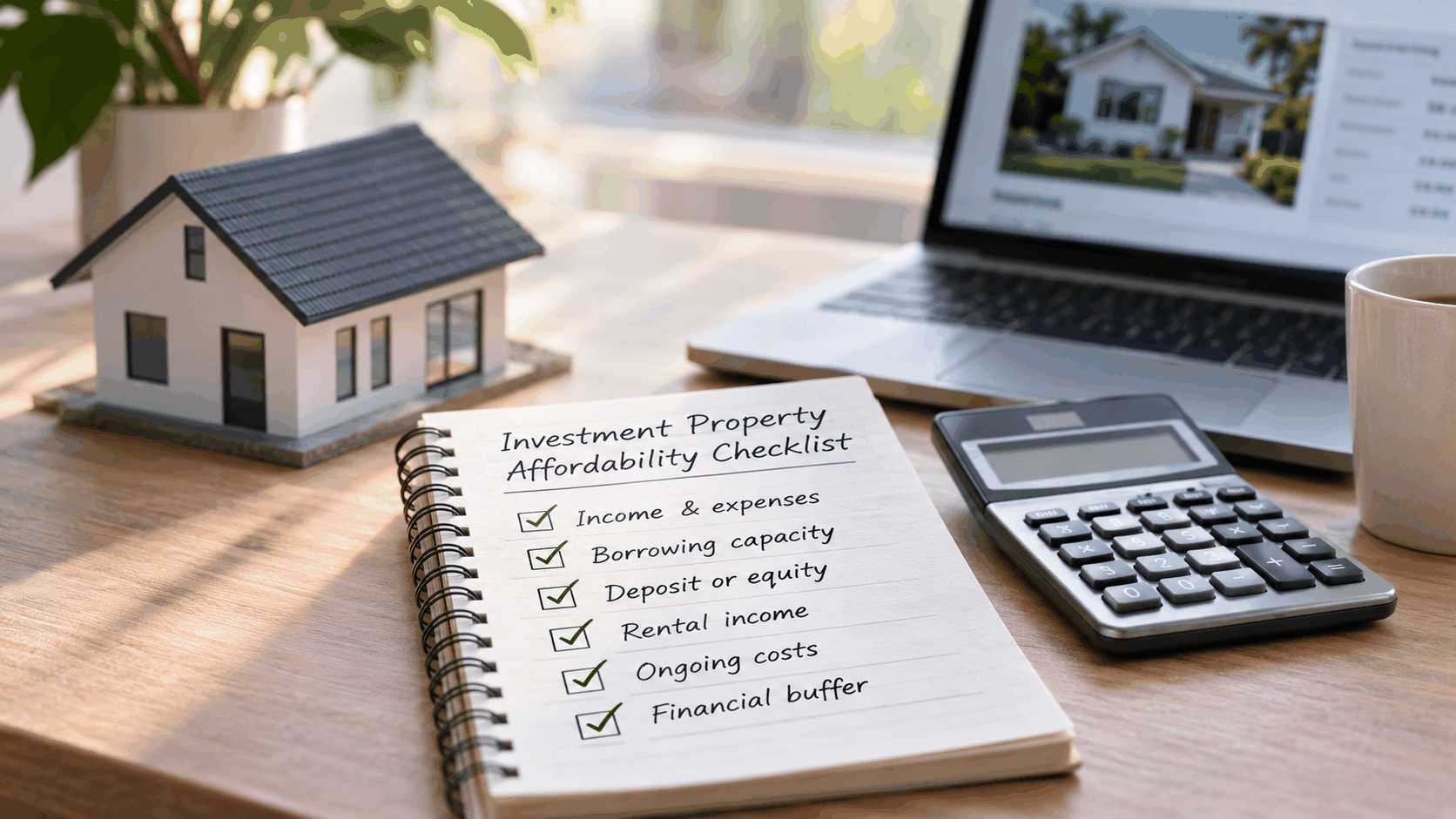
15. Your Investment Property Affordability Checklist
Before making an offer, work through the following questions.
- What is my household income after tax?
- How much do I spend each month?
- What existing loans and credit commitments do I have?
- How much could I potentially borrow?
- How much deposit or usable equity is available?
- Have I calculated all upfront purchase costs?
- What is a realistic rental income estimate?
- What are the expected monthly ownership expenses?
- How much would I need to contribute from my own income?
- Could I manage the property without rent for several weeks?
- What happens if interest rates increase?
- Will I have sufficient accessible savings after settlement?
- Could I continue holding the property if my personal circumstances changed?
- Does the purchase support my longer term financial goals?
- Have I reviewed the financing arrangements before committing to a contract?
If you’re unsure about several answers, it may be worth reviewing your finances before proceeding.
A clear understanding of your position can help you avoid searching for properties that don’t fit your financial circumstances.
Frequently Asked Questions
How much income do I need to buy an investment property in Australia?
There is no single minimum income that applies to every investor. Lenders consider your earnings alongside existing debts, living expenses, dependants, deposit and expected rental income. Your individual borrowing assessment will help determine what may be achievable.
Can I afford an investment property on a $100,000 salary?
Potentially. A $100,000 salary may support investment borrowing in some circumstances, but the amount available depends on your financial commitments and the lender’s assessment. Someone with no existing mortgage may have different borrowing options from someone already carrying substantial debt.
Can I buy an investment property with a 10% deposit?
Some lenders may consider investment property loans with a 10% deposit, subject to eligibility and lending criteria. Lenders mortgage insurance and additional requirements may apply. You’ll also need funds for relevant purchase expenses.
Can I buy an investment property while paying rent?
Yes, potentially. Some investors purchase rental properties while continuing to rent their own accommodation. However, lenders will consider your existing rent and other commitments when assessing repayment capacity.
Does rental income help me qualify for an investment loan?
Rental income may contribute to borrowing capacity. However, lenders generally assess eligible rental income using their own requirements and may recognise less than the full advertised amount.
How much savings should I have left after buying?
The appropriate amount depends on your circumstances, including employment stability, existing commitments and the property’s expected expenses. Consider keeping sufficient accessible funds for personal emergencies, vacancies and unexpected maintenance.
Should I borrow the maximum amount a lender offers?
Not necessarily. The maximum amount available under a lender’s assessment may be greater than the amount you’re personally comfortable repaying. Your purchase budget should reflect your financial priorities and tolerance for risk.
Is buying an investment property worth it?
That depends on the property, your financial position, investment objectives and the risks involved. Rental income and potential capital growth may offer benefits, but ownership costs, debt and possible changes in property value need careful consideration.
Make an Informed Investment Property Decision with NMC Finance
Buying an investment property is a significant financial commitment.
The right starting point isn’t necessarily finding the perfect property. It’s understanding what you can comfortably afford and how the finance will fit your current circumstances and future plans.
At NMC Finance, we help Australian property investors review their borrowing position, compare suitable lender options and consider finance structures that support their investment goals.
With more than 20 years of finance experience, our team understands that each investor’s circumstances are different.
Whether you’re purchasing your first investment property, using equity from an existing home or planning another addition to your portfolio, we can help you understand your available financing options.
Ready to explore what you could afford?
Visit our Property Investor Loans page to learn more about investment finance options and arrange a conversation with NMC Finance.
Disclaimer: This article provides general information only and does not constitute personal financial, investment, legal or taxation advice. All calculations are illustrative. Lending eligibility, rates and terms depend on individual circumstances and lender approval. Seek appropriate professional advice before making property investment decisions.